
Abortion with the Bitter Waters
BREAKFAST BIBLE STUDY
Numbers 5:11-31 (NIV)
3/9/2025
“Christian nationalism is just fascism cloaked in religious garb” – Grace Pecker
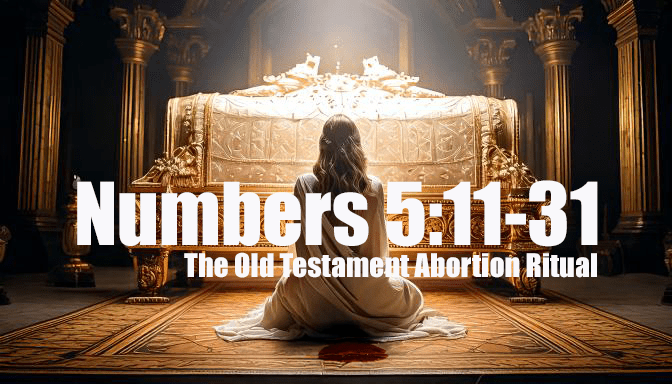
When Christian and Grace opened the Bible this morning for breakfast Bible study, I was ready for any tricks. This time of year, chores only take about half the day, so I had time to look up any passages that they could say were wrong. I looked up all the stuff on war and slaves and sex and have answers ready for them about what God really meant.
“You look tired this morning, Cole,” Grace said. “Is that your second cup of coffee?”
“I was up late reading,” I said. “I’m ready for breakfast Bible study. What’s the passage?”
“The ordeal of the bitter waters,” Grace said.
“Um.”
“You’ve never heard of it?” Grace said.
“What’s it about?”
“Abortion,” Christian said as he started the bacon. “Maybe abortion. Most likely abortion. The translations are various and disputed. The good thing is that ritualistic magic doesn’t work.”
“The Bible says all of that’s wrong,” I said.
“You don’t have to read the passage aloud,” Grace said. “It’s kind of long. Numbers 5:11-31. It’s a law regarding jealous husbands.”
“And unfaithful wives,” Christian said.
“Accused of being unfaithful,” Grace said. “Without proof.”
“What does that have to do with abortion?” I said.
“Read.”
“‘Then the Lord said to Moses, “Speak to the Israelites and say to them: ‘If a man’s wife goes astray and is unfaithful to him so that another man has sexual relations with her, and this is hidden from her husband and her impurity is undetected (since there is no witness against her and she has not been caught in the act), and if feelings of jealousy come over her husband and he suspects his wife and she is impure—or if he is jealous and suspects her even though she is not impure—then he is to take his wife to the priest. He must also take an offering of a tenth of an ephah of barley flour on her behalf. He must not pour olive oil on it or put incense on it because it is a grain offering for jealousy, a reminder-offering to draw attention to wrongdoing.’”’”
“Wait,” I said. “God says she was unfaithful.”
“So she’s bound to fail the ordeal,” Grace said.
“What does that mean?” I asked.
“She’s presumed guilty by God even though no proof exists,” Grace said.
“God’s all-knowing,” I said.
“Then what’s the point of the ordeal?” Grace said.
“I better read this,” I said.
“‘“‘The priest shall bring her and have her stand before the Lord. Then he shall take some holy water in a clay jar and put some dust from the tabernacle floor into the water. After the priest has had the woman stand before the Lord, he shall loosen her hair and place in her hands the reminder-offering, the grain offering for jealousy, while he himself holds the bitter water that brings a curse. Then the priest shall put the woman under oath and say to her, ‘If no other man has had sexual relations with you and you have not gone astray and become impure while married to your husband, may this bitter water that brings a curse not harm you. But if you have gone astray while married to your husband and you have made yourself impure by having sexual relations with a man other than your husband’—here the priest is to put the woman under this curse—’may the Lord cause you to become a curse among your people when he makes your womb miscarry and your abdomen swell. May this water that brings a curse enter your body so that your abdomen swells or your womb miscarries.
“‘Then the woman is to say, “Amen. So be it.”’”’”
“Wait,” I said. “How does she stand before the Lord?”
“I think it means the altar,” Grace said.
“The curse is to miscarry?” I said. “That means losing the baby, right? That’s not good. I better keep reading.”
“‘“‘The priest is to write these curses on a scroll and then wash them off into the bitter water. He shall make the woman drink the bitter water that brings a curse, and this water that brings a curse and causes bitter suffering will enter her. The priest is to take from her hands the grain offering for jealousy, wave it before the Lord and bring it to the altar. The priest is then to take a handful of the grain offering as a memorial offering and burn it on the altar; after that, he is to have the woman drink the water. If she has made herself impure and been unfaithful to her husband, this will be the result: When she is made to drink the water that brings a curse and causes bitter suffering, it will enter her, her abdomen will swell and her womb will miscarry, and she will become a curse. If, however, the woman has not made herself impure, but is clean, she will be cleared of guilt and will be able to have children.’”’”
“Wait,” I said. “The stuff she drank is like an abortion drug? I thought the Bible said abortion was wrong, but here, the priest is making her drink something that kills the baby, and then the woman becomes a curse. What does that mean?”
“Some translations have the woman dying along with the baby,” Christian said. “Apologists claim that this ritual never would have been performed on a pregnant woman…but this might defeat the purpose of the ritual. A jealous husband wouldn’t want to raise the child of another man. The ordeal fixes that. Either the woman is pregnant, or she’s not. If she’s not, she winds up sterile. If she is, the baby dies…and it tracks with other passages about infidelity that the mother would die as well.”
“That’s even worse,” I said. “This has to be some sort of mistake.”
“It’s no mistake,” Grace said. “But Christian is right. This ritual would not work. If the woman would miscarry or become sterile or die, it would be the result of some sort of poisoning.”
“But the Bible says abortion is wrong,” I said.
“Where?”
“Jeremiah,” I said. “God says he knows us in the womb. He says that—”
“That’s not what Jeremiah says,” Christian interrupted. “God is speaking specifically to Jeremiah and says he knew Jeremiah before he was formed in the womb.”
“There’s a psalm too,” I said.
“Psalm 139?” Grace asked. “‘Knit together in my mother’s womb…and intricately woven in the depths of the earth.’ Is that an edict against abortion?”
“Yes,” I said. “The Bible also says shed no innocent blood.”
“And yet cities are slaughtered in the name of God,” Grace said.
“They weren’t innocent, maybe,” I said.
“Even the boy children,” Christian said. “Even the babies who are dashed against the rocks?”
“This isn’t fair,” I said. “I don’t like this. You keep doing war and sex and stoning and stuff.”
“The Bible says a lot of things, Cole,” Grace said. “Some of those things contradict each other. My question: do you honestly believe teachers should be forced to teach the ordeal of the bitter waters?”
“Probably not,” I said. “Pastor Mercer said the Bible was good science. Can we do science or something like that next time?”

In state legislatures across the country, Christian fundamentalists are passing laws meant to force the teaching of the Christian Bible in public schools. From the posting of textually inaccurate iterations of the Ten Commandments on the walls of classrooms to the incorporation of the “Trump Bible” across multiple pedagogical disciplines, these laws and mandates are sweeping the reddest parts of this nation.
The height of hypocrisy is banning books in the name of “protecting children” while mandating one particular book rife with numerous acts of sexual violence and scenes of graphic violence and genocide.
Book bans are dangerous. The Bible is worth reading and exists online and in public school libraries across the country, but proponents of mandating its formal teaching in public schools need to know what it actually says.
My books are a lot more fun than breakfast Bible study.







© Copyright UNBATED Productions 2025
 The JESUS Journals