
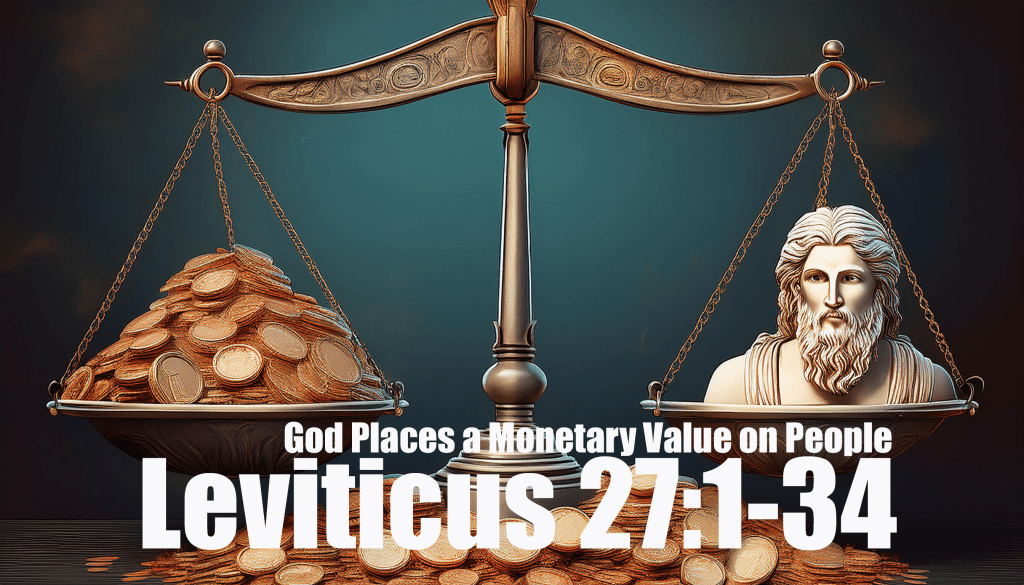
God Places a Monetary Value on People
BREAKFAST BIBLE STUDY
Leviticus 27:1-34 (NIV)
4/6/25
“Christian nationalism is just fascism cloaked in religious garb” – Grace Pecker
Because Donald Trump is crashing the stock market with his stupid trade war that is meant to give himself and his billionaire friends tax breaks that all other Americans will fund by paying tariffs, Christian, Grace, and I had to go through a bunch of papers for the farm insurance, health insurance, life insurance, car insurance, and all that policy junk.
Also, we export much of our grain because American farmers produce more food than Americans can eat every year, so now we have to worry about other countries placing tariff on the food we export — tariffs which their consumers will have to pay (unless they get cheaper grain from smart countries that do not do stupid things like trade wars.)
In other words, we have to do a financial wellness check to make sure we survive this year.
We have a bunch of policies under several umbrellas (that are not real umbrellas but are figures of speech). Christian always looks for ways to save money and gets angry because him getting older, on top of inflation costs, makes all the insurance policies go up in price from year to year.
“Cole, we can save thousands of dollars every year if you just raise our deductibles,” Christian said. “On the vehicles, raising it from $250 to $1000 will save us a ton.”
My spreadsheet financial plans (along with some of the bad things that have happened in the Four Corners) tell me not to raise our deductibles. Also, I know how to convert pounds to dollars, but I’m not sure how to convert tons to dollars.
“Is a ton like 2,000 in dollars or pounds?” I asked. “How do I set up the formula?”
“What?” Christian said.
“I don’t think we’d save two thousand dollars,” I said, “especially if we have an accident. We’re usually cash poor by the end of summer, but we’re not cash poor enough to need to risk high deductibles on everything.”
“Tons was a figure of speech,” Christian said.
“Cole’s right,” Grace told Christian. “Things aren’t going to get better these next four years. We’re going to be dealing with a lot of risk. Insurance will help.”
“Hey, wait,” I said as I read some of the fine print in the policies. “You guys have to pay more in health insurance, but I have to pay more in car insurance.”
“Because you’re a younger driver,” Christian said, “and Grace and I are older, meaning we have greater health risks.”
“So that means we pay more for this umbrella?” I asked.
“We should all get checkups,” Grace said, “while we know our health insurance and vaccines still exist. The flu shot is already tanked for next winter thanks to worm brain.”
“Who’s that?”
“The anti-vax soft eugenics idiot destroying our health agencies,” Christian said.
“I can’t keep everybody in Trump’s junk door straight with all their nicknames,” I said as I started reading the fine print on our life insurance. “I just know that Gestapo Botox Barbie used to be our crooked governor. I don’t like ICE.”
“They’re horrible people,” Grace said. “That’s all you need to remember.”
“This isn’t fair,” I said. “I’m reading about how the insurance company won’t pay as much on accidental death if old people or children die. Kids aren’t worth very much. Old people aren’t either.”
“It has to do with what a person contributes to family income,” Christian said. “People outside the workforce aren’t considered as valuable as those who are in the workforce.”
“That’s not very fair,” I said. “And we have Christian insurance!”
“Christian companies not acting so Christian?” Grace said. “Shocker.”
“They should make it fair for everybody,” I said. “That’s all I’m saying.”
“Insurance companies need to make money to stay in business,” Christian said. “Even Christian insurance companies.”
“Jesus didn’t care about money,” I said. “He said don’t worry about that stuff…like the birds don’t worry. Maybe they should follow the Bible more and care more about people instead of how much money they make.”
“We make money on this farm,” Grace said.
“We feed people,” I said. “People need food. We don’t charge more for young people or old people to keep our farm going. We do everything fair and square…just like Jesus.”
“I think the Bible might disagree,” Christian said.
“Where?”
So, now we have a boring breakfast Bible study that is almost as boring as looking at the insurance stuff. According to Leviticus, God sets the rates for how much people are worth. According to Christian, a shekel might have been a month’s worth of work back in bible times. According to the Bible, God told Moses what everybody was worth. Back then, people did vows and stuff to have blessings from the priest, and they could dedicate their slaves or children to the priests for labor, which still sounds wrong to me. When people wanted to get their slaves or children back, they could pay money to the priests. God’s insurance table went like this:
The Lord said to Moses, “Speak to the Israelites and say to them: ‘If anyone makes a special vow to dedicate a person to the Lord by giving the equivalent value, set the value of a male between the ages of twenty and sixty at fifty shekels of silver, according to the sanctuary shekel for a female, set her value at thirty shekels, for a person between the ages of five and twenty, set the value of a male at twenty shekels and of a female at ten shekels, for a person between one month and five years, set the value of a male at five shekels of silver and that of a female at three shekels of silver; for a person sixty years old or more, set the value of a male at fifteen shekels and of a female at ten shekels. If anyone making the vow is too poor to pay the specified amount, the person being dedicated is to be presented to the priest, who will set the value according to what the one making the vow can afford.” Leviticus 27:1-34.
“Oh,” I said. “But it’s good they were kind of fair to poor people.”
“Sure, but they were still squeezing the poor people for blessings,” Grace said.
“It’s how the priestly class stayed in business,” Christian said. “They weren’t doing any actual work, but they were making money.”
“Wait,” I said. “How come women were worth less than men?”
“There’s a shocker,” Grace said.
“It probably had to do with physical strength,” Christian said. “I’ve known tough women, I’ve known weak men, but on average, men tend to be physically stronger than women. Men worked the fields. Woman reared children and handled domestic tasks…generally speaking.”
I looked to Grace for a scolding. Instead of saying anything, she handed the spatula to Christian and sat with her arms crossed, meaning she was on strike. Christian hopped from the table, flipped a pancake to make sure it was done, and flipped that pancake right onto my plate.
“What I’m saying is generally true, Grace,” Christian said. “There are women out there who could beat my ass, but they are the exception, not the rule.”
“And kids aren’t very strong,” I said. “That’s why they’re worth less?”
“And the elderly,” Christian said. “In agrarian societies, people were valued for the work they could do in the fields. Today, that still kind of applies.”
“But Moses wasn’t doing any of this on farmland,” I said. “They were in the desert collecting manna and stuff. The desert would have different rules.”
“Maybe, just maybe,” Christian said. “These laws were written hundreds of years later, when people were farming in the Levant?”
“Moses never made it to the Promised Land,” I said. “Wait, he must have known they would make it to the Promised Land. He wrote these laws knowing they’d get there.”
“Sure,” Christian said. “And wrote the laws down in Hebrew, even though that language wouldn’t exist in written form for hundreds and hundreds of years.”
“Well, he was pretty smart,” I said. “Wait, how much was a newborn worth?”
“What do you mean?” Christian asked.
“It says how much a baby is worth if it’s older than one month,” I said. “How much is a newborn worth?”
Christian took the Bible from me and scanned the page.
“Grace?” he asked.
“With extreme infant mortality rates,” Grace said. “I doubt the priests placed much value on newborns, considering they were very likely to die.”
“No, it probably has to do with breastfeeding,” I said.
“Mothers breastfeed longer than a month,” Grace said. “But, Cole, you said that insurance companies shouldn’t place value on people, especially Christian insurance companies. Your brother just showed you a passage where God does just that.”
“So that priests could make money doing nothing but blessings and curses?” I asked.
“Probably beats getting a real job,” Christian said.
“But, wait, Jesus hated money! He preached more about money than anything else.”
“Yet, Judas carried money for the group, according to the Gospel of John,” Grace said.
“Sure, they had money, but they weren’t buying people and stuff,” I said.
“Jesus was a reformer,” Christian said. “That’s why he got sideways of the Temple.”
“Yep,” I said. “And…wait, do we have to hate money too?”
“We don’t live above or beyond our means,” Grace said. “We donate. We do what we can, maybe not as much as Dad, but we’ve learned lessons from the past.”
“So…”
“We live in the real world, buddy,” Christian said. “Jesus preached as if the world was going to end. If the end were near, which is what people believed, nobody would need money. It happens today. People in cults think the end is near, so they rid themselves of material things.”
“But…”
“The world’s still spinning?” Christian said. “The Christian message evolved when it became apparent Jesus wasn’t coming back anytime soon. A day is a thousand years. A thousand years is like a day. Those pastoral letters renegotiating Jesus’ quick return into a long return were written long after Jesus died and once it became apparent that Jesus was not, in fact, making a speedy come back. In my humble opinion, those later authors were adjusting the message when the expectations of the early church were not met. That’s what happens to end-time ministries to this day. Churches evolve or die. But, back to Leviticus: In my opinion, bilking people of their hard-earned money and claiming it’s for their own good is one of the oldest religious cons.”
“Is tithing a con?” I asked.
“Tithing means giving ten percent,” Grace said.
“That’s interesting,” Christian said. “Trump put a universal ten percent tariff on all imports. It’s a number meant to decimate in the literal sense…to punish or slowly bleed people of their wealth. I’m thinking that this number is no coincidence.”
“I don’t get it,” I said.
“I bet if you line up the amount Trump expects to take in tariffs,” Christian said, “it will line up with the amount he wants to cut in taxes for his billionaire friends.”
“Stealing from the poor to give to the rich,” Grace said, “the opposite of what Jesus would do.”
“Can we go back to fun stories next week with miracles and stuff that you guys don’t believe?” I asked. “The money laws are boring. Money is the worst part of farming.”

In state legislatures across the country, Christian fundamentalists are passing laws meant to force the teaching of the Christian Bible in public schools. From the posting of textually inaccurate iterations of the Ten Commandments on the walls of classrooms to the incorporation of the “Trump Bible” across multiple pedagogical disciplines, these laws and mandates are sweeping the reddest parts of this nation.
The height of hypocrisy is banning books in the name of “protecting children” while mandating one particular book rife with numerous acts of sexual violence and scenes of graphic violence and genocide.
Book bans are dangerous. The Bible is worth reading and exists online and in public school libraries across the country, but proponents of mandating its formal teaching in public schools need to know what it actually says.
Check out my adventures with Christian, Grace, and a bunch of others below.









© Copyright UNBATED Productions 2025
 The JESUS Journals