
Balaam’s Ass
BREAKFAST BIBLE STUDY
Numbers 22: 21-38 (NIV)
4/13/25
“Christian nationalism is just fascism cloaked in religious garb.” – Grace Pecker
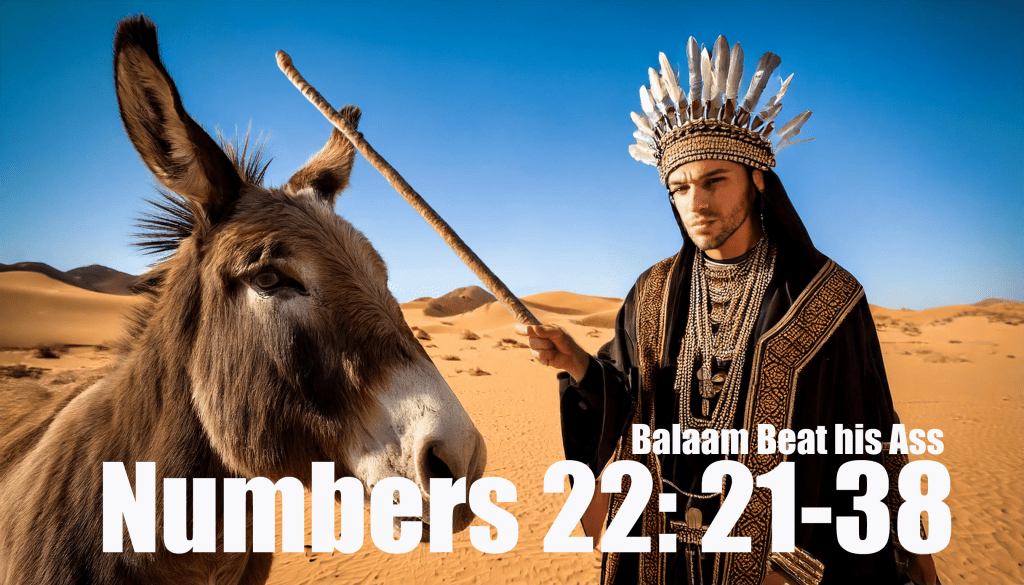
Since I went to Wednesday Bible study at church this week and learned about Balaam’s talking donkey, which is not the same donkey Jesus rode on Palm Sunday, Grace and Christian decided to let me run breakfast Bible study this morning and teach the story to them. That meant they could share the chores of cooking breakfast and doing the dishes. Grace thought it was weird that they would be teaching an Old Testament story right before Holy Week, but I explained that the teaching was that false prophets sometimes speak the truth and that in the New Testament, Peter warned not to take money for your preaching or something.
“Cole, was this a series of classes?” Christian asked.
“Yep, but I only sat in on the one,” I said.
“So…you may not have the full context of the Bible study?” Christian asked.
“I think they summarized it all pretty good,” I said. “It was the last class.”
“And the message?” Christian asked.
“Some churches teach false teachings, like Balaam did,” I said. “They’re only out to make money, so you should watch out for those churches.”
“Any churches that accept money?” Grace asked.
“No, just the ones that make false teachings and take money,” I said.
“How do you know which churches are false?” Christian said.
“Ones that aren’t like our church,” I said. “I mean, you guys don’t usually go, but the church we went to when we were growing up.”
“Don’t other churches say our church has heretical teachings?” Grace asked.
“Do they?” I asked.
“Sure,” Christian said. “That’s why there are so many denominations with different interpretations of the Bible.”
“But I think I know the good part of the story,” I said. “It’s funny. Balaam has a talking donkey. It’s a female donkey, too.”
“Meaning?” Grace said.
“I don’t know.”
“Why does the donkey talk?” Christian asked.
“Because Balaam hits it three times,” I said. “The donkey could see the angel of the Lord, but Balaam couldn’t, even though he was supposed to be a great seer.”
“So, Balaam wasn’t such a good seer after all?” Christian asked.
“Nope.”
“Why does the angel of the Lord show up?” Grace asked.
“To stop him from seeing this king named Balak,” I said.
“Why does he want to go see King Balak?” Christian said.
“He’s going to get money to curse the Israelite people, but he doesn’t do that,” I explained.
“Who tells him to go see Balak?” Christian asked.
I page through the Bible because I cannot remember that part, but I do remember that a bunch of princes came to see Balaam to bring him to Balak, but God told him not to go.
“God tells him not to go,” I said.
“Then why does he go?” Christian asked.
“See, in Numbers 22: 12, God tells Balaam not to go with the people, and then Balaam tells the people to go home, for ‘the Lord refuses me to go with you.’ That’s because he was not supposed to curse the Israelite people like Balak wanted.”
“But he goes anyway?” Christian asked.
“They offered him a bunch of money the next time they came back,” I said. “That’s why he did the bad thing by going.”
“He did?”
“Yep.”
“What’s the next verse say?” Christian asked.
“‘That night God came to Balaam and said, “Since these men have come to summon you, go with them, but do only what I tell you.”’ But…he wasn’t supposed to go.”
“That’s not what you just read,” Christian said.
“But wait,” I said. “God let him because of free will to make money…um. Wait, what?”
“It’s your lesson,” Grace said.
“Wait,” I said. “God lets him go, but then the Lord gets angry about it. Is it because he got up early without them summoning him like God warned?”
“Are you asking me?” Christian asked.
“I think that was in the lesson,” I said.
“Is that what the Bible says?” Christian asked.
“Not exactly.”
“Then what happens?” Grace said.
“Next is the part about the donkey, which is funny, except he beats the donkey.”
“Why didn’t the angel of the Lord reveal himself right away?” Christian asked.
“Because the donkey was smarter than Balaam,” I said. “I remember that part.”
“So…the donkey had to suffer a beating to prove that point?” Grace asked.
“I’m sorry.”
“You didn’t write it,” Christian said.
“I don’t get what it means,” I said.
“What happens after the episode with the donkey?” Christian asked.
“Balaam gives all sorts of blessings to the people of Israel,” I said. “Instead of cursing the people, he blesses them. That part’s really long and boring.”
“That’s strange,” Christian said.
“See, sometimes people can speak the word of God, but they still can be bad.”
“Did Balaam take money from Balak?” Grace asked.
“He was a prophet for hire,” I said.
“Not unlike the priests of Aaron who put a valuation on people for profit?” Grace asked.
“That’s different,” I said. “The priests of Aaron were Israelite priests.”
“So prophecy for profit is okay for the priests of Aaron?” Christian asked.
“Not with slaves and stuff.”
“And Balaam took money from Balak?” Christian asked.
“Um,” I said. “Give me one hour to read the rest of it.”
After an hour, I came back without the Bible and with a headache from so much reading again and again to find the part about money.
“Well?” Christian said.
“Balak gets mad because Balaam wouldn’t curse them,” I said. “It doesn’t say anything about Balaam getting paid by Balak, which is what the Bible study said. I probably missed it, but I couldn’t find it anywhere.”
“Did you look at all the other references in the Bible that suggest that Balaam’s sin was taking money for prophecy?” Grace asked.
“I couldn’t find them all,” I said. “But the story doesn’t say anything about him taking money from Balak. It says Balaam spoke exactly what God told him.”
“If you took out the story of the donkey—”
“But that’s the funny part, kind of,” I said.
“If you took out the story of the donkey, what happens then?” Christian asked.
“Um.”
“Is Balaam completely obedient to God with the donkey story deleted?” Christian said.
“I guess,” I said. “But he was a prophet taking money and stuff.”
“Cole, did you notice that sometimes the word God is used in the text, and sometimes the word Lord is used?” Christian said.
“I was wondering about that,” I said. “In the donkey part, it says an angel of the Lord, but in most of the rest of it, it says God. But it’s the same, right?”
“Maybe not,” Christian said. “Most scholars believe that the Bible was written based on multiple oral traditions over many years. God—Elohim—was used in the northern kingdom. The Lord—Yahweh—was used in the southern kingdom.”
“Yep,” I said. “It’s the same.”
“Most scholars believe that the story of the donkey was a late addition to the story to make Balaam look dumber than a donkey,” Christian said.
“How come?”
“He wasn’t a part of the nation of Israel, was he?” Christian said.
“But he spoke to God for money,” I said.
“He blessed Israel and didn’t take money from Balak apparently,” Christian said.
“But I heard he did,” I said.
“But the text here doesn’t actually say that,” Christian said. “It’s a tricky story, open to a lot of interpretation. Later, in Numbers 39, Balaam evidently told Balak how to entice the people of Israel with prostitution and idolatry, but that comes later.”
“And it’s scapegoating,” Grace said. “Just like Adam scapegoats Eve in the garden.”
“So Balaam was bad or not?”
“He’s somewhat complicated and contradictory. This complexity is either the product of being human or being the product of redaction and reinterpretation,” Christian said. “Now, you’ve always said that God can do anything, but what does the story of a talking donkey sound like? Think of other stories that are not in the Bible.”
“That one Disney movie with the funny donkey called Donkey?” I said.
“The biblical account of Balaam’s ass sounds a little like a fairy tale, doesn’t it?”
“It’s in the Bible,” I said. “But maybe it’s like a metaphor or something?”
“Maybe it is,” Christian said. “Maybe it happened. Maybe not. I don’t think it did. I do think Balaam, or a Balaam cult, might have existed.”
“How come?”
“Archaeology from the eighth century BCE,” Christian said.
“They had archaeology way back then?”
“No,” Christian said. “But back in the 1960s, they found text in a Canaanite language that referenced Balaam’s extra-biblical prophecies. He was a character known in the ancient world. I have a feeling that later writers of the Bible wanted to make him look dumber than a donkey.”
“Somebody besides Moses wrote about him?” I said.
“Balaam was a known figure in the region. That’s why I think the story of the donkey might be a late addition to the Old Testament,” Christian said. “Maybe to make a point about prophecy for profit. Maybe to discredit the Balaam cult.”
“They could just add stuff to what Moses wrote?”
“Why not?”
“Because Moses wrote it?” I said.
“You don’t sound sure,” Grace said.
“History is much more complicated than what you typically learn in Bible study,” Christian said. “Bible study is about faith. History is about fact.”
“I think it’s because they were adding stuff in Bible study that wasn’t really there, maybe,” I said. “I think they were adding interpretations and stuff that I don’t see on the page.”
“That’s called apologetics,” Christian said. “The church and biblical scholarship often conflict in that regard.”
“Who’s right?”
“Depends,” Grace said. “What’s more important to you, fact or faith?”
In state legislatures across the country, Christian fundamentalists are passing laws meant to force the teaching of the Christian Bible in public schools. From the posting of textually inaccurate iterations of the Ten Commandments on the walls of classrooms to the incorporation of the “Trump Bible” across multiple pedagogical disciplines, these laws and mandates are sweeping the reddest parts of this nation.
The height of hypocrisy is banning books in the name of “protecting children” while mandating one particular book rife with numerous acts of sexual violence and scenes of graphic violence and genocide.
Book bans are dangerous. The Bible is worth reading and exists online and in public school libraries across the country, but proponents of mandating its formal teaching in public schools need to know what it actually says.
I have three ducks in my fourth book, but they don’t talk to me much.










© Copyright UNBATED Productions 2025
 The JESUS Journals