
Babel Might Have Scared God
BREAKFAST BIBLE STUDY
Genesis 11:1-9 (NIV)
5/4/25
“Christian nationalism is just fascism cloaked in religious garb” – Grace Pecker

This week, I reminded Christian how I had been hit on the head by the people trying to steal our corn after he first came back to the Corners and Jesse was here. He reminded me of how I wore a pimp suit and bought an emerald for Jesse to ask her to marry me, which embarrassed me again, so I asked him if Google Translate would cause problems like the Tower of Babel.
See, I knew that the Chinese people stealing our corn were Chinese because I opened Google Translate on my phone, and that wasn’t racist.
They were telling each other to run and hide when they saw me, according to Google Translate. I told the FBI they might have been North Koreans speaking Chinese, but the FBI agreed that they were probably Chinese.
“Cole, why are you bringing this up again?” Christian asked.
“I was thinking that God may get mad if everybody can understand each other,” I said. “Just like God got mad at the Babel people. They were prideful and stuff.”
“Were they?” he asked.
“Yep,” I said. “So, God created a whole bunch of languages and spread the people everywhere. That’s what the story says. He doesn’t want people to be proud like that.”
“And you think Google Translate may reverse the effects of the Tower of Babel and bring about God’s wrath?”
“Could it?”
“I think you need to take a look at that story again,” Christian says.
“For breakfast Bible study?”
Christian sighed.
“I don’t see what’s wrong with teaching it in school,” I said.
“It’s a myth and not how languages were created,” Christian said. “Linguists have a good idea how languages evolve and are evolving.”
“Who are they?”
“People who study language,” Christian said. “Right now, languages are dying all over the world.”
“Because of Google Translate?”
“Because of colonialism,” Christian said. “Some languages only have a few speakers left. It’s happening all over the world, even here.”
“We’re not going to be able to speak American?” I asked.
“The imposition of English and other colonial languages on indigenous peoples has caused much language collapse here and around the world.”
“But American will be okay?”
“Cole, you know that American is English.”
“Without the foofy-poof sounds in the throat,” I said.
“English has many dialects,” Christian said. “We have an American Midwestern dialect.”
“But we sound normal,” I said. “We don’t have a drawl or poof-paws or anything.”
“We sound funny to other people,” Christian said. “If we didn’t have modern communication or modern transportation, it could happen that people down where Jesse lives and people from here couldn’t understand each other after a while.”
“I wouldn’t be able to talk to Jesse?” I asked.
“She’s from here,” Christian said, “but if the language shifted enough, language divergence would happen. All languages have dialects and linguistic cousins.”
“Even English?”
“English and German have a common root,” Christian said. “French and Latin influenced English heavily. We’ve borrowed words from all over the world. That’s how languages spread and evolve. Even the Lakota people who live here have several dialects in their language. A few generations back, First Nations who lived far enough apart geographically would have trouble understanding each other. Languages and dialects evolved on this continent for thousands of years without the influence of any Tower of Babel. Hundreds of those languages still exist.”
“Is that why they had sign language?”
“Yes, but my point is that that’s how it is all over the world. All languages are related and have common branches and roots. Most European languages have an Indo-European root, except Basque. That language is a holdover from a far more ancient language group that was pushed out of Europe.”
“How do you know this stuff?” I asked.
“I had to learn the basics of other languages in the Navy,” he said. “Understanding linguistics helped me learn those languages. The story of the Tower of Babel did not.”
“Maybe it was different back then,” I said. “Maybe there was one language, God spread them out because he was mad at their pride, and then they Indo-something and changed more. That’s what probably makes the most sense.”
“Maybe,” Christian said. “But what makes you think God was mad?”
“Um.”
“We should read that story Sunday morning,” Christian said. “You run the lesson and explain it to me and Grace.”
“Can I make notes first?”
“Sure,” Christian said.
Since I get to run the lesson, I try to make a bunch of notes, but Jesus warned his disciples just to speak whatever came to mind when they were captured and stuff. Christian and Grace finished eating and sat with their hands folded, ready for me to teach them.
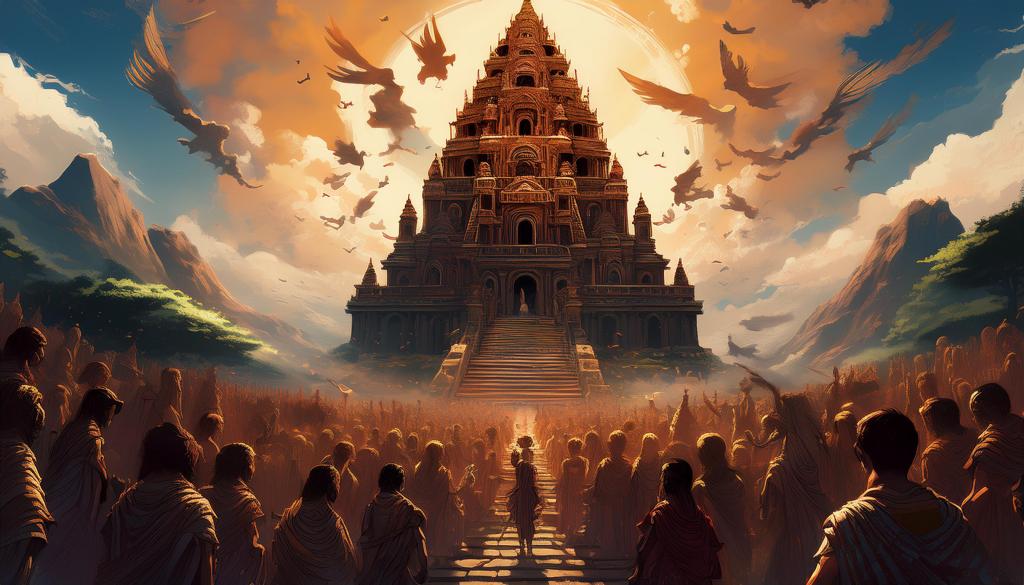
“‘Now the whole world had one language and a common speech. As people moved eastward, they found a plain in Shinar and settled there.’”
“Where’s that?” Grace asked.
“That’s Babylon,” I said. “That’s where the exile was, but that was later.”
“A great and mighty empire,” Christian nodded.
“‘They said to each other, “Come, let’s make bricks and bake them thoroughly.” They used brick instead of stone, and tar for mortar. Then they said, “Come, let us build ourselves a city, with a tower that reaches to the heavens, so that we may make a name for ourselves; otherwise we will be scattered over the face of the whole earth.”’”
“What does it mean to make a name for themselves?” Grace asked.
“That’s the pride part,” I said.
“They wanted to be a great and mighty empire?” Christian asked.
“Yep,” I said. “But God wanted them to be tribes.”
“But didn’t the flood just happen?” Grace asked. “How many tribes were there?”
“Maybe two dozen,” I said. “Israel had twelve tribes for sure. See, people lived for hundreds of years. That gave them the chance to have lots of babies.”
“But I thought Abraham was the father of that nation,” Christian said. “I didn’t think he had been born yet.”
“These were other tribes,” I said. “They wanted to build a nation. God didn’t like that.”
“Why not?”
“It was prideful,” I said.
“Why?” Grace asked.
“Um.”
“Did Moses forbid it?” Grace asked. “Which law were they breaking?”
“Um,” I said. “Moses wasn’t born yet to give them the laws.”
“If there weren’t laws yet, how did they know they were doing anything wrong?” Christian asked.
“It was prideful,” I said. “That’s the lesson.”
“You can keep reading,” Christian said.
“‘But the Lord came down to see the city and the tower the people were building. The Lord said, “If as one people speaking the same language they have begun to do this, then nothing they plan to do will be impossible for them. Come, let us go down and confuse their language so they will not understand each other.”’”
“Wait,” Grace asked. “Why did God have to come down?”
“Huh?”
“Why did God have to come down?” Grace asked again. “Couldn’t he see them from Heaven? Or wasn’t the tower tall enough yet?”
“Um,” I said. “He would come down for stuff like that back then.”
“With whom?” Grace asked.
“Angels and stuff?” I asked.
“I’m asking you,” Grace said.
“Maybe Jesus and the Holy Spirit?”
“Why didn’t Moses just write ‘Jesus and the Holy Spirit’ then?” Grace asked.
“Ease up on him, Sis,” Christian whispered to Grace. “He’ll get there.”
“Would you agree that God doesn’t seem alone in this story?” Grace asked.
“Maybe not,” I said. “Wait, in the book of Job, he had a whole council and stuff. It was probably them.”
“You can keep going, Cole,” Christian said.
“‘So the Lord scattered them from there over all the earth, and they stopped building the city. That is why it was called Babel—because there the Lord confused the language of the whole world. From there the Lord scattered them over the face of the whole earth.’”
“Even Antarctica?” Grace asked.
“No,” I said. “Too cold for people there.”
“Cole, is it possible that this is just a fun myth to explain how languages developed?” Christian asked.
“I looked that up,” I said. “The Babylonians had a bunch of ziggurat towers.”
“I thought they stopped building because God confused their language,” Grace said. “Now, they have multiple ziggurats?”
“Um.”
“Could it be that the creator of this story saw these ziggurats while in captivity—maybe even saw one incomplete—and told this story to thumb his nose at his captors?” Christian asked. “Would that be an explanation? A lot of cultures have legends like this. The Greek gods lived on Mount Olympus. The lightning and storms served as proof of Zeus.”
“But they’re not in the Bible,” I said.
“He’s right,” Grace said. “They’re not. What about that, Christian Pecker?”
Sometimes, I like when Grace takes my side, but I think she might be teasing me this time by only pretending to take my side.
“Cole,” Christian said. “You said God was angry. Where in the text does it say that?”
I ran my fingers over the words again and again, looking for something about God’s wrath, like happens in most other Old Testament stories.
“See, God said that nothing they would do would be impossible,” I said.
“And he’s mad about that?” Christian asked.
“He scattered them,” I said.
“But where is he angry?” Christian asked.
“Wait,” I said. “Was…was God worried?”
“He seemed to be concerned that man would accomplish anything,” Grace said.
“Like going to the moon or something?” I said.
“It did take several thousand years to accomplish that feat,” Christian said.
“Wait, so why was I taught that God was mad in Sunday school?”
“Well, we talked about tribal gods,” Christian said. “These tribal gods held power over their territories. Maybe in the original oral tradition, these gods teamed up because humanity was gathering to create powerful city-states—city-states that could gather armies and crush tribes. Maybe they teamed up to make sure that humans didn’t become too powerful.”
“But…there’s only one God,” I said.
“That’s what you believe,” Christian said. “That’s what you were taught. Back then, people didn’t believe that. So, just maybe, Christians reinterpret the story for modern times by adding that God is angry rather than worried. Is that possible?”
“But it should just say that then because that’s how it is.”
“But it doesn’t say that,” Grace said. “A lot of these stories don’t say what we were told they said in Sunday school. People have reinterpreted them to fit their particular theology. In this case, the lesson for us was that we should know our place. We have proverbs about pride, but the Tower of Babel makes for a better object lesson. Only, the text does not support what we were taught in church.”
“But God doesn’t change his nature or his mind or get scared,” I said. “I know that one for sure. That’s all over the Bible. He knows everything from beginning to end. It’s right in the Greek.”
“You’re right,” Christian said. “It is. Book of Revelation. Alpha and Omega.”
“I get to be right?” I asked. “Yes!”
“Amos or Jonah next week?” Christian asked Grace.
“Take your pick,” Grace said.
“You’re going to show me that I’m wrong next week, aren’t you?” I said.
In state legislatures across the country, Christian fundamentalists are passing laws meant to force the teaching of the Christian Bible in public schools. From the posting of textually inaccurate iterations of the Ten Commandments on the walls of classrooms to the incorporation of the “Trump Bible” across multiple pedagogical disciplines, these laws and mandates are sweeping the reddest parts of this nation.
The height of hypocrisy is banning books in the name of “protecting children” while mandating one particular book rife with numerous acts of sexual violence and scenes of graphic violence and genocide.
Book bans are dangerous. The Bible is worth reading and exists online and in public school libraries across the country, but proponents of mandating its formal teaching in public schools need to know what it actually says.
I have some Spanish in my last book. I’m not good at other languages.








© Copyright UNBATED Productions 2025
 The JESUS Journals