
God Changes His Mind, Relents, Feels Sorry, and has Pity
BREAKFAST BIBLE STUDY
Amos 7:1-6 (NLV, NIV, KJV, ICB)
5/11/25
“Christian nationalism is just fascism cloaked in religious garb” – Grace Pecker
Christian and Grace think they always can trick me at breakfast Bible study because they went to Bible class until they were eighteen, and I had to quit when Mom and I had to leave the church after Dad died because of her accusations. They know way more about the Bible, but I think I am catching up to them. Last week, they even gave me a clue that they were going to pick verses from Amos or Jonah. These are short books. In Jonah, a fish swallows him before he preaches against Nineveh. In Amos, God is mad at his people for not being pure and threatens to destroy everything if people aren’t good. A lot of the little books with the prophets have stuff about God being mad and making plagues and pestilence and war and junk like that. Normally, Christian and Grace would probably tell me that kids should not read about an angry God, but I think they want to prove that God changes his mind. I read both books this week and did not find that at all. We had breakfast outside this morning because the weather was finally nice enough. Grace made omelets. Christian has his Bible bookmarked. I am ready for him to talk about Jonah because he has already told me that a fish cannot swallow a person in real life.
“Amos?” I asked when I opened his Bible. “God is pretty angry in that one.”
“These verses are actually pretty soft,” Christian said.
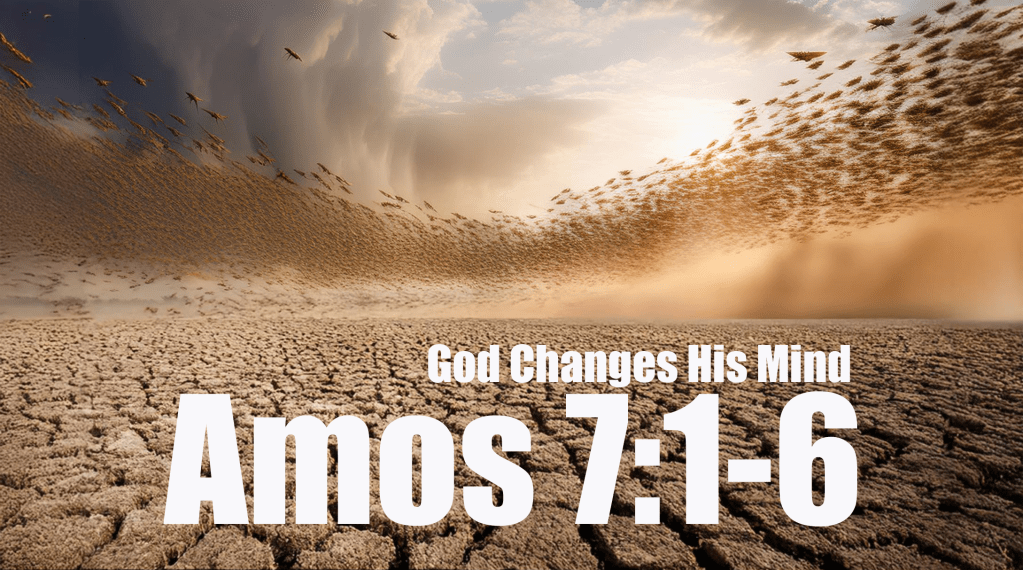
I read: “‘This is what the Lord God showed me: He was making a gathering of locusts when the spring grain began to grow. The spring grain was after the king’s share had been cut. When they had finished eating the grass I said, “Lord God, forgive! O that Jacob may stay alive for he is so small!” So the Lord changed His mind about this. “It will not be,” said the Lord.’”
“What did the Lord do?” Christian asked.
“That’s not what I remember,” I said. “It must be a copyist error.”
“When we get pests,” Grace said. “Is it God’s wrath?”
“We have pesticides,” I said. “They probably didn’t have those back then.”
“Keep reading,” Christian said.
“‘This is what the Lord God showed me: The Lord God was calling for a punishment by fire. It dried up the deep waters and began to destroy the farmland. Then I said, “Lord God, I beg You to stop! How can Jacob stay alive, for he is so small?” So the Lord changed His mind about this. “This also will not be,” said the Lord God.’”
“What does God do on those two occasions?” Christian said.
“Changes his mind,” I said, “but I don’t…that’s not right. Wait right here.”
I ran into the house and grabbed my Bible and every other Bible I could find, except for the Pecker Family Bible, which Christian keeps in the safe. I opened them each to Amos to find the passages that Christian had me read.
“You have a bad translation,” I told him. “My version says that God relented. I know what that word means. It means to make something less severe.”
“So…God was going to be severe, then God changed his mind and was less severe?” Christian asked. “That still sounds like he changed his mind.”
“That’s not what mine says,” I said, pushing another Bible at him. “Read this one.”
“This version says God took pity,” Christian said.
“Cole, you sound angry,” Grace said.
“It’s because you guys aren’t being fair,” I said.
“Being fair to whom?” Grace said.
“To the Bible,” I said.
“Which Bible?” Christian said.
“There’s only one Bible,” I said.
“Then why do these different translations say different things?” Christian said.
“I don’t know.”
“Cole,” Grace said. “The Bible has been getting translated for thousands of years.”
“And they make copyist errors,” I said.
“So, which one is the copyist error?” Christian said.
“Your version where God changes his mind,” I said.
“How do you know?” Grace said.
“Because God doesn’t change his mind,” I said.
“Have you read the original Hebrew to be sure?” Christian said.
“I can’t read all those chicken scratches,” I said.
“Well, getting as close to the source material is probably the best way to figure out which version is most accurate,” Christian said. “I don’t read much Hebrew either.”
“So, wait, how can you be sure that your version is correct?” I said.
“I can’t,” Christian said. “The oldest version of Amos known, I’m guessing, comes from the Dead Sea Scrolls. Those were written closer to the time of Jesus than Amos.”
“And what do those say?” I said.
“I haven’t read them, Cole,” he admitted.
“So, you don’t know,” I said.
“Why do you think there are multiple versions of these passages in modern translations?” Christian asked.
“Copyist errors?”
“Maybe so,” Christian said. “Or just maybe, modern translators have some bias. If you want God to change his mind, that’s how you translate it. If you don’t want God to change his mind, you say God took pity or relented.”
“But what did God really do?” I asked.
Christian shrugged.
“The New Testament isn’t like that,” I said. “Especially, the Gospels. They’re scripture.”
“Then why was there early debate in the church about what should be included in the canon and what should be excluded?” Grace asked.
“They had cannons back then?” I asked. “I thought it was just swords and stuff.”
“Canon with one N,” Christian said. “It means a body of written work.”
“Why was their debate about scripture even thousands of years ago?” Grace asked.
“I don’t know,” I said.
“People decide these things,” Christian said, “while God remains pretty quiet.”
“Not in the Gospels,” I said. “Jesus was right there. He had eyewitnesses.”
“Matthew, Mark, Luke, and John were eyewitnesses?” Grace said. “All four of them?”
“Yep,” I said. “That’s why there are some differences. No two eyewitnesses report things the same.”
“You’re probably right,” Grace said.
“I get to be right for once again?” I asked.
“Maybe,” Grace said. “Let’s take a look at that next week.”

In state legislatures across the country, Christian fundamentalists are passing laws meant to force the teaching of the Christian Bible in public schools. From the posting of textually inaccurate iterations of the Ten Commandments on the walls of classrooms to the incorporation of the “Trump Bible” across multiple pedagogical disciplines, these laws and mandates are sweeping the reddest parts of this nation.
The height of hypocrisy is banning books in the name of “protecting children” while mandating one particular book rife with numerous acts of sexual violence and scenes of graphic violence and genocide.
Book bans are dangerous. The Bible is worth reading and exists online and in public school libraries across the country, but proponents of mandating its formal teaching in public schools need to know what it actually says.
In my sixth book, we have hail and a fire that traps me.






© Copyright UNBATED Productions 2025
 The JESUS Journals