
Jephthah Roasted His Nameless Daughter for God
BREAKFAST BIBLE STUDY
Judges 11: 29-40 (NIV)
6/1/25
“Christian nationalism is just fascism cloaked in religious garb” – Grace Pecker

Last night, Christian, Grace, and I roasted our first marshmallows on a campfire out back for fun on a Saturday night. We stayed up late, telling stories about growing up in the Four Corners. I thought I knew everything about Christian and Grace, but they did lots of things during the ten years before I was born. For a while, they were even best friends, kind of like they are starting to become best friends now. The campfire last night was not the reason for today’s breakfast Bible study, but it kind of fits because Christian and Grace say this story involves a bonfire.
This story is about a Biblical judge named Jephthah and his daughter, who goes unnamed for some reason. They tell me I can read the story quietly because they both had some drinks last night and would prefer a little peace and quiet:
“Then the Spirit of the Lord came on Jephthah. He crossed Gilead and Manasseh, passed through Mizpah of Gilead, and from there, he advanced against the Ammonites. And Jephthah made a vow to the Lord: ‘If you give the Ammonites into my hands, whatever comes out of the door of my house to meet me when I return in triumph from the Ammonites will be the Lord’s, and I will sacrifice it as a burnt offering.’
“Then Jephthah went over to fight the Ammonites, and the Lord gave them into his hands. He devastated twenty towns from Aroer to the vicinity of Minnith, as far as Abel Keramim. Thus Israel subdued Ammon.
“When Jephthah returned to his home in Mizpah, who should come out to meet him but his daughter, dancing to the sound of timbrels! She was an only child. Except for her he had neither son nor daughter. When he saw her, he tore his clothes and cried, ‘Oh no, my daughter! You have brought me down and I am devastated. I have made a vow to the Lord that I cannot break.’
“‘My father,’ she replied, ‘you have given your word to the Lord. Do to me just as you promised, now that the Lord has avenged you of your enemies, the Ammonites. But grant me this one request,’ she said. ‘Give me two months to roam the hills and weep with my friends, because I will never marry.’
“‘You may go,’ he said. And he let her go for two months. She and her friends went into the hills and wept because she would never marry. After the two months, she returned to her father, and he did to her as he had vowed. And she was a virgin.
“From this comes the Israelite tradition that each year the young women of Israel go out for four days to commemorate the daughter of Jephthah the Gileadite.”
Because I have heard this story before, I have few questions. I even know where to find Gilead on a map. Jesus preached on the Sea of Galilee. Southeast of where Jesus preached, on the east side of the Jordan River, are mountains where Jephthah lived.
“Jephthah won,” I said, “But he thought an animal would come out of his home. People lived on the second floor. Animals lived at ground level where the door was. Instead of an animal, it was his daughter who came from the door. She had to become a nun or something and never could get married.”
“Where does it say that?” Christian asked.
“Um,” I said. “That’s what we learned in Sunday school.”
“But does the text say that?” Christian said.
“She had to go with friends to those hills in Gilead to mourn because she would never get married or have children.”
“Why would you think she would become a nun?” Grace asked.
“Moses didn’t allow human sacrifice,” I said. “Even though that’s what some people say this story means.”
“Jephthah was from Gilead,” Grace said. “He fought common enemies for Israel and ruled for six years, but that doesn’t mean he followed Mosaic law. Human sacrifice was practiced in the region.”
“Just like Samson and other judges,” Christian said, “Mosaic law doesn’t really play a role in the stories of the judges. It’s almost as if some of these oral traditions predate Mosaic law, which was most likely borrowed from other cultures and set down in writing much later than Moses by priests and scribes using him as an authoritative voice.”
“I’m not sure all what you said means, but the judges were pretty sinful,” I said.
“But Jephthah worshiped God,” Grace said. “The Spirit of the Lord even came upon the man when he went into battle. God must have thought he was pretty special.”
“Um,” I said. “Sure, and he made a bad vow, forcing his daughter to become a nun or something. That’s the lesson. Think through your vows.”
“Where does it say she became a nun in the story, Cole?” Grace asked.
“Don’t make bad vows,” I said. “She had to become a nun.”
“Jephthah said he would burn anything that came from his house as a sacrifice to the Lord,” Christian said.
“She didn’t die,” I said. “She became a nun or something.”
“Is that what the text says?” Christian asked.
“Not exactly,” I said. “Wait, what does it say?”
“He promised to burn anything that came from his home as a sacrifice to the Lord,” Grace said.
“So…wait, he burned his daughter or something?” I asked. “That’s not what I heard.”
“That’s probably why the story was memorable for the people of ancient Israel,” Christian said. “The key to the story is at the end. The young women commemorate Jephthah’s daughter for four days every year. These would have been illiterate women, in all likelihood, passing the story down through oral tradition. The folktale likely slipped into the written tradition like other stories from Judges.”
“The women telling the folktale were not only mourning Jephthah’s daughter but also their own lot in life,” Grace said. ”Folktales that survive into the written record likely were the ones that resonated with the people through the generations.”
“Because she became a nun,” I said. “Grace would be upset if she became a nun.”
“I’m bisexual,” Grace said. “I’d survive.”
“I’m not sure they had that in biblical times,” I said.
“They did,” Grace said. “Hence, laws involving same-sex male relations.”
“Cole, do people usually commemorate people who live?” Christian said.
“Maybe they did back then,” I said.
“Jephthah was pretty upset his daughter came from his house to greet him,” Grace says. “The act of tearing your clothing is an act of profound grief. The passage doesn’t describe the burnt sacrifice, but the implication is strong that he burned his daughter as a sacrifice to the Lord.”
“He wasn’t from Israel,” I said.
“People have tried to use apologetic reinterpretation to excuse the sacrifice, going so far as to add plot points where they do not exist,” Christian said, “but the man vowed a burnt sacrifice. I believe the story and the apologetic rationalization you were taught are both repugnant.”
“I didn’t mean to be repugnant,” I said. “He really burned his daughter to death?”
“What does the text say?” Grace asked.
“He did the vow,” I said. “Why didn’t God stop him like he stopped Abraham.”
“Maybe because this text is meant to explain a well-known tradition that existed from a time when human sacrifice was common.”
“It was common?”
“If you have to bend yourself into knots to suggest the text isn’t saying what it’s saying,” Christian said, “you are probably dealing with an inconvenient but well-known story important to the populace. That’s my guess. Ancient deities were cruel, which helped explain the cruelty people faced when enduring famine, disease, and warfare.”
“God could have stopped him, but he didn’t?” I asked. “But he stopped Abraham.”
“Jephthah’s daughter doesn’t even get a name,” Grace said. “This is probably a folktale that predated laws that forbade human sacrifice. Virgin sacrifice was probably practiced until animals stood in as proxies for human beings.”
“Why didn’t God stop it?” I said. “I thought Jephthah was holy. He was a judge.”
“Back then, burnt sacrifices were meant as food for the gods,” Grace said. “That’s why the best animal is the one given to the priests for sacrifice. Jephthah’s daughter was the best sacrifice he could present to God because it came at great cost. It’s right there in the word—sacrifice. Giving up his daughter to the priesthood would have been a smaller sacrifice than giving his daughter to the flame so that God could eat. Jephthah wouldn’t tear his clothes over losing his daughter to the priesthood. The human sacrifice is what makes the story unique enough to be recorded, rash vow or not. A tradition existed. Scribes tried to make sense of it thousands of years ago. Christians try to explain it away to this day. Their arguments are weak.”
“In the story, which likely has a factual basis in some tradition, Jephthah made a vow,” Christian said. “Jephthah fulfilled that vow. That’s what we know. Was it a rash vow? From a Christian perspective, that’s the lesson. The lesson hits harder with Jephthah’s daughter dying. Serving God as a nun, as you put it, is indeed a sacrifice, but not one powerful enough to warrant four days of commemoration. I think the people who recorded this story understood that Jephthah sacrificed his daughter on a bonfire. That’s what I believe, but what do you think, Cole?”
“It’s kind of scary,” I said. “And probably not appropriate for any children to hear.”
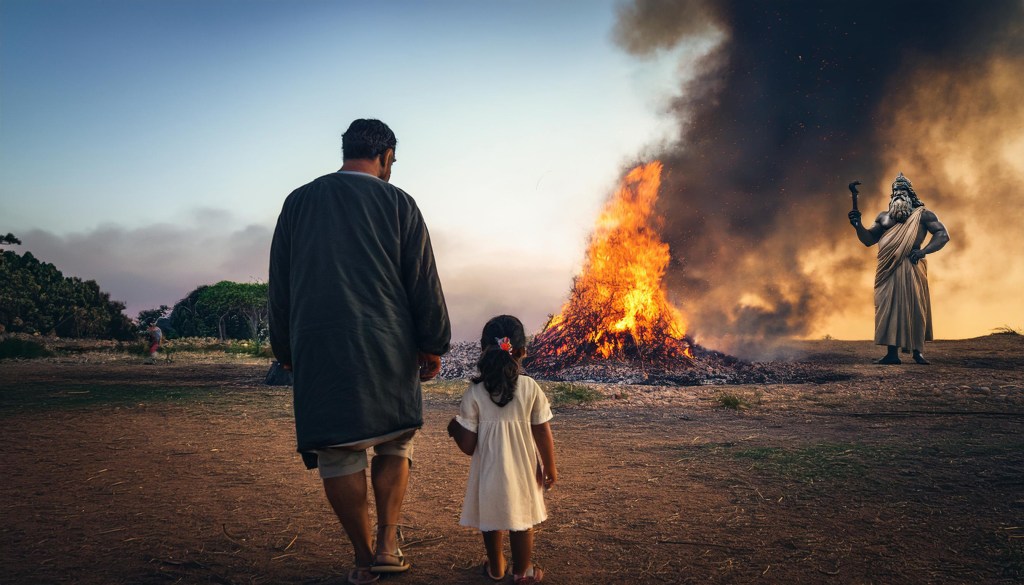
In state legislatures across the country, Christian fundamentalists are passing laws meant to force the teaching of the Christian Bible in public schools. From the posting of textually inaccurate iterations of the Ten Commandments on the walls of classrooms to the incorporation of the “Trump Bible” across multiple pedagogical disciplines, these laws and mandates are sweeping the reddest parts of this nation.
The height of hypocrisy is banning books in the name of “protecting children” while mandating one particular book rife with numerous acts of sexual violence and scenes of graphic violence and genocide.
Book bans are dangerous. The Bible is worth reading and exists online and in public school libraries across the country, but proponents of mandating its formal teaching in public schools need to know what it actually says.
Check out my adventures with Christian, Grace, and a bunch of others below.







© Copyright UNBATED Productions 2025
 The JESUS Journals