
BREAKFAST BIBLE STUDY
Evil Spirits Come from God?
1 Samuel 16: 15
6/29/25
“Christian nationalists should spend less time seeking power and more time reading the words Jesus preached.” – Christian Pecker

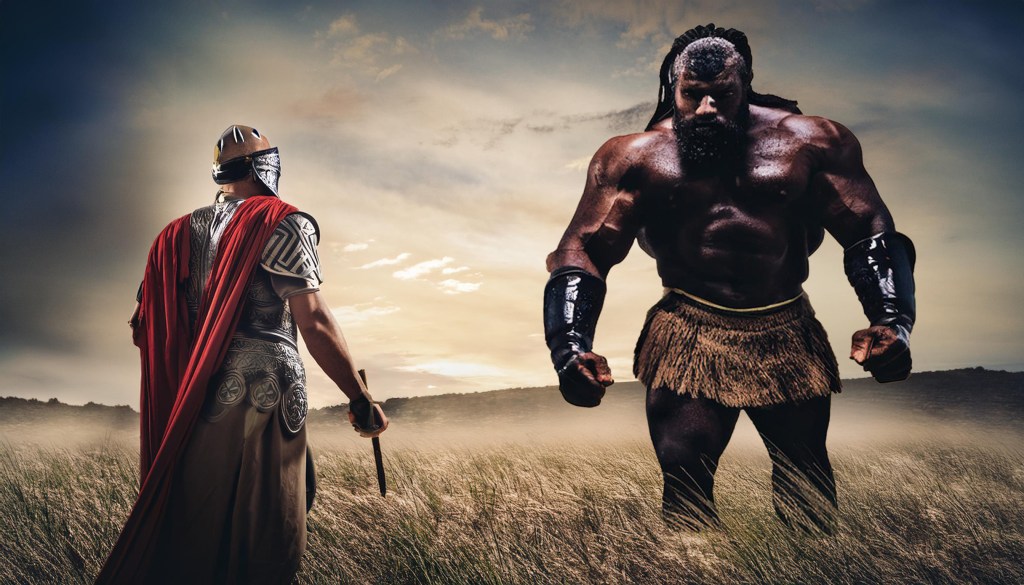
Since I knew Grace and Christian would pick David and Goliath this week to try to trick me about how Goliath died, I read a whole bunch of the books of Samuel to find out everything I could about King David. I even looked on the Internet for all the apologetics stuff to help me. The apologetics stuff explained a bunch of things I had not even noticed about the David story, but now I also see why Christian thinks that a bunch of people might have been writing the Bible from different parts of Israel and making changes. Both explanations make sense, but I still believe in the Bible.
When Grace and Christian came to breakfast, they found that I had a breakfast casserole in the oven, almost ready to eat, because I wanted them both to listen to all I had learned.
“See, you don’t even need to bring the Bible. I know what you’re going to say,” I told them.
“What are we going to say?” Grace asked.
“It kind of says that David killed Goliath with a sling,” I said, “and he chopped off his head, and Goliath died. It’s just rhetoric, though. The stone got buried in Goliath’s head. That killed him. David cut off his head to bring it back to Saul to prove Goliath was dead. With his head off, we really knew that Goliath was dead for sure.”
“That sounds like a fair assessment,” Christian said.
“There’s more that you think will be wrong,” I said. “See, in chapter 16, one of the young men tells Saul that he’s seen ‘a son of Jesse the Bethlehemite who is skillful in playing, a man of valor, a warrior, prudent in speech, and a man of good presence, and the Lord is with him.’”
“It’s a hero’s description,” Grace said.
“And then in chapter seventeen, ‘Saul said to David, “You are not able to go against this Philistine to fight with him, for you are just a boy, and he has been a warrior from his youth.”’ Even though some Bibles change it to David being a young man, to make it fit with chapter sixteen, where it said David was a man, not a boy.”
“Which translation is correct?” Christian said. “Is David a boy or young man?”
“We don’t know David’s age in either chapter,” I said.
“But in chapter sixteen, David is described as a valiant man, a warrior,” Christian said. “And in chapter seventeen, David is described as a boy or young man incapable of fighting Goliath. You don’t see that as a contradiction in these descriptions of David?”
“But he wins and kills him with the sling and chops his head off,” I said.
“Pretty violent story to be telling school children,” Grace said.
“Oh, we’re still kind of doing the Bible-in-public-schools thing?” I asked.
“Can’t we do both?” Christian said.
“But everybody’s heard about David and Goliath,” I said. “The Greeks even heard about it. They steal the story for Achilles. He killed somebody, just like David did.”
“The battle between David and Goliath is probably an older story,” Christian agreed.
“David was quite the role model for the ancient world,” Grace said.
“Yep, for all the good stuff he did, not all the bad stuff,” I said.
“The hagiography elevated him,” Christian said, “as hagiographies tend to do.”
“What’s that?” I asked.
“A very admiring story,” Grace said. “Usually about saints.”
“Did you find anything else interesting about David and Goliath?” Christian asked.
“See, but there’s lots of explanations that I found. Maybe the messenger was lying in chapter sixteen about David being older. Maybe Saul didn’t recognize David because he had been taken by an evil spirit so many times.”
“An evil spirit from whom?” Grace asked.
“Um, yep, I think it says the evil spirit came from God for some reason,” I said.
“I thought evil spirits were satanic,” Grace said.
“Um,” I said. “See, but God’s all-powerful, so he allowed the evil spirit to get Saul,” I said.
“Maybe,” Christian said. “Or people at the time this was written didn’t have a concept of demonic forces. Maybe, the concept of demons didn’t develop until after the Babylonian exile, so during David’s time, whether good or evil, all spirits came directly from God. How about that?”
“Or he had lots of people in his court,” I said. “Or maybe a lot of time had passed. See, people say the story comes from two different sources, which isn’t true.”
“You’re talking about the strangeness of an older David playing the lyre in chapter sixteen,” Christian asked, “and a younger David fighting Goliath in seventeen?”
“See, but they wouldn’t have known who Jesse was, maybe,” I said. “That’s what I think. Saul asks about David’s father. Saul maybe had memory problems.”
“Those are some good apologist explanations you found on the Internet,” Grace said. “Why didn’t the Bible explain any of that? Why does it take modern interpretation?”
“Um.”
“Is it just as likely that these two stories came from two separate traditions?” Christian said. “Wouldn’t that be a simpler explanation? Wouldn’t it also make sense that when these stories were compiled before the Babylonian exile, people had no concept of demons from Hell?”
“See, but it got the bronze stuff right,” I said. ‘It’s how they fought with champions.”
“David was a product of transition, when Egypt and the Hittites were withdrawing from the region. The Bronze Age was ending. The Iron Age was beginning,” Christian said. “It was a time when local rulers like Saul and David could rise to power. David’s a complex character, imperfect no doubt, but beloved by his people.”
“So…I’m right about which part then?” I asked.
“These passages about David have been debated for years,” Christian said. “These passages are only a problem if you believe the Bible is univocal and inerrant. Can’t they just be good stories cobbled together from multiple oral traditions?”
“But there’s lots of explanations to make the Bible those two words you just said about the Bible being perfect,” I said.
“There are,” Christian said. “And any one of them could be true, but I like the simpler approach. In storytelling, it’s hard to report everything as it exactly happened…especially when it’s been passed down from oral tradition.”
“How do you know it wasn’t written when David was alive?” I asked.
“The earliest proto-Hebrew text is, indeed, found during that era,” Christian said, “but scholars aren’t quite sure what it says.”
“It’s pro-David?” I asked.
“It’s probably not about David, but the pottery is still being deciphered,” Christian said. “The earliest proto-Hebrew text that’s been found is from pottery shards with words on them, words maybe containing legal matters.”
“Did the pottery get changed by scribes like you say people did with the Bible?” I asked. “You always say they’re doing that.”
“Pottery can’t be changed once it’s been fired. That’s why the find is important,” Christian said. “The pottery can be dated, giving people a picture of how and when the language developed. On the other hand, most scholars believe scribes refined the books of Samuel over hundreds of years, well after the events took place. As stories are refined, fabrication often takes place. Samuel is interesting. Some later ancient texts leave out big chunks of the narrative, but those chunks exist in older texts. We just don’t have the earliest source material. That’s the problem with paper versus pottery. Scribes can’t rewrite pottery. We do know scribes were making changes to the text because variations exist between ancient texts, just like variations appear in modern translations.”
“So, it could be written from people’s memories, and sometimes, memory isn’t so good for getting to the facts?” I asked.
“That’s a good way of putting it,” Grace said. “These stories about David were probably extremely popular. He became a mythic figure, maybe even more mythic than historical. I think you found some good stuff to talk about this week, Cole.”
“Why are you letting me win, kind of?”
“It’s not about winning,” Grace said. “We just want you to think about what you’re reading. You’re doing that.”
“But…is King David a good role model for children?” Christian asked.
“Um, he kind of does some bad stuff later on,” I said.
“Power corrupts?” Grace said.
“That would be a good lesson for kids in public schools,” I said. “Teachers could teach kids that power corrupts. We don’t want kids to get corrupted by power.”
“Do you think that’s a good lesson Christian nationalists would like taught in schools?” Grace said. “What if, for example, a teacher compared the sexual immorality of King David to the sexual immorality of President Trump? Would Christian nationalists like that?”
“Probably not.”
“What if teachers taught that evil spirits come from God, as Samuel claims when describing Saul’s affliction,” Christian said. “What if teachers teach exactly what the text says without any apologetics.”
“I don’t know any Christians who would like that,” I said, “nationalist or regular.”
In state legislatures across the country, Christian fundamentalists are passing laws meant to force the teaching of the Christian Bible in public schools. From the posting of textually inaccurate iterations of the Ten Commandments on the walls of classrooms to the incorporation of the “Trump Bible” across multiple pedagogical disciplines, these laws and mandates are sweeping the reddest parts of this nation.
The height of hypocrisy is banning books in the name of “protecting children” while mandating one particular book rife with numerous acts of sexual violence and scenes of graphic violence and genocide.
Book bans are dangerous. The Bible is worth reading and exists online and in public school libraries across the country, but proponents of mandating its formal teaching in public schools need to know what it actually says.
Some themes in my books below might not be appropriate for children.







© Copyright UNBATED Productions 2025
 The JESUS Journals