
BREAKFAST BIBLE STUDY
Jesus Blesses Poor People
Luke 6:20 (NIV)
1/11/26
“Blessed are you who are poor, for yours is the kingdom of God.”
– Jesus
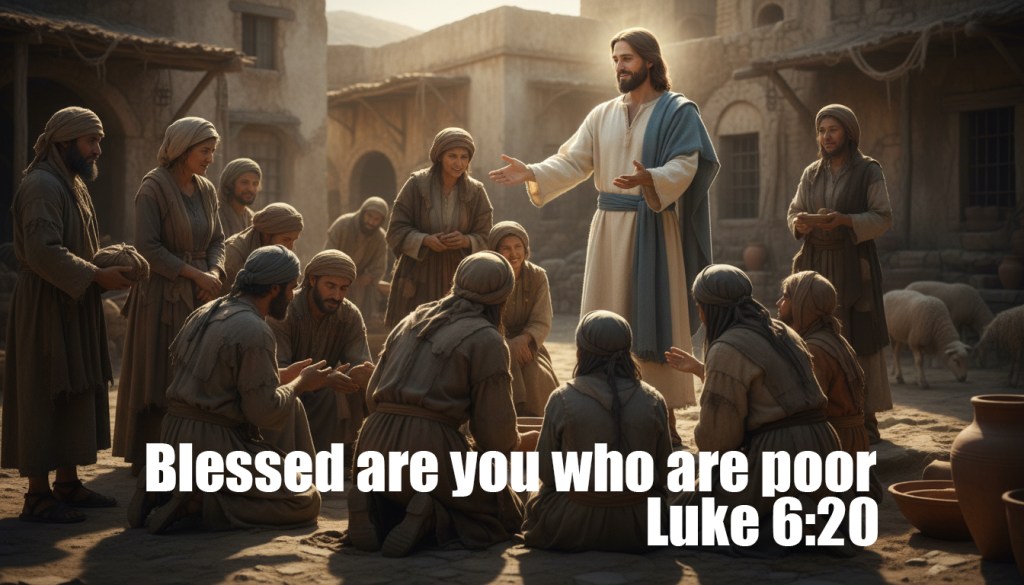
Since the weather is cold and the days stay dark until after I normally eat breakfast, I have coffee while I wait for my brother and sister, who both like to sleep until sunrise. This gives me a chance to do some financial work in my spreadsheets to see which donations we should make this year before paying taxes.
“You’re already at work?” Grace asked when she finally came to the kitchen.
“I’m looking at numbers,” I said, “and waiting for breakfast Bible study. I want to see how much we can donate this year to United Way.”
“Didn’t you do that last month?”
“This is for this year,” I said. “I think we can give the same as last year.”
“Cole looks like he’s hard at work,” Christian said when he finally joined us.
I folded my laptop closed and grabbed my Bible. “This week, we do a good one that Jesus probably said that the Christian nationalists won’t like. I’ve been waiting all week for this. Is it going to be hard?”
“They don’t like the beatitudes,” Grace said. “I thought we would cover the first this week.”
“Which version?” Christian said. “Blessed are the poor or blessed are the poor in spirit?”
“They have different versions?” I asked.
“Luke blesses ‘the poor,’” Christian said. “Matthew blesses ‘the poor in spirit.’”
“Which one did Jesus say?” I asked.
“We don’t know,” Grace said. “Maybe both. Maybe neither.”
“Which one is better?” I asked.
“If you are socially conscious, which you are, you would prefer Luke,” Grace said.
“Scholars debate why Matthew rendered the passage ‘poor in spirit,’” Christian said.
“We’re not poor,” I said. “I don’t know what the second one means for sure.”
“Poor in spirit might mean spiritually helpless or downtrodden,” Grace said. “One is about actual poverty. You can be both. You can be one or the other or neither. Matthew might be broadening Luke’s beatitude to include people longing for spiritual health. He’s not giving commandments. He’s offering hope in both Luke and Matthew. He does it in Mark and John, too.”
“Christian nationalists don’t like this passage?” I asked. “I suppose not. They like it when ICE murders moms. I don’t like ICE, even if you don’t believe they punched out one of my teeth. I think Trump is making ICE like those Nazis, even though Nazis weren’t scared enough to wear masks. Masked ICE Nazis are way worse than ICE under Biden, even though Biden deported more people through the courts and stuff, which I don’t really like either. ICE under Trump are like terrorists or something. They swear a whole bunch, too. I’ve seen the videos. I don’t know if Jesus would like that.”
“The beatitudes are central to Jesus’ teachings,” Christian said. “His core ethics are embedded in those teachings…and, yes, he probably would have disliked ICE, too. If you believe his family fled to Egypt in his infancy, then you have to acknowledge that Jesus was a refugee.”
“That’s what I was thinking,” I said. “Christian nationalists want immigrants out of our country, especially the poor ones. They don’t like helping people around the world with food programs and stuff. They think poor people are freeloaders, even kids who need free or reduced lunch at school. They think that Trump is great because he’s rich. I don’t think Trump is poor in spirit, just in morality. They want to hurt people who may need mental help. They want to take away all the programs that help people.”
“Not all of them think that way, I hope, but many of them do,” Christian said.
“What would Jesus think of all that?” Grace asked.
“Hurting poor people? I don’t think Jesus would like that at all,” I said. “I think this passage should be taught in public schools, but I’m guessing Christian nationalists would disagree. So…if they hate poor people and cheer innocent people being murdered on the street, Christian nationalists don’t follow Jesus’ teachings at all.”
“Isn’t it troubling how Christian love has dovetailed so effortlessly with MAGA hate!” Grace said.
In state legislatures across the country, Christian fundamentalists are passing laws meant to force the teaching of the Christian Bible in public schools. From the posting of textually inaccurate iterations of the Ten Commandments on the walls of classrooms to the incorporation of the “Trump Bible” across multiple pedagogical disciplines, these laws and mandates are sweeping the reddest parts of this nation.
The height of hypocrisy is banning books in the name of “protecting children” while mandating one particular book rife with numerous acts of sexual violence and scenes of graphic violence and genocide.
Book bans are dangerous. The Bible is worth reading and exists online and in public school libraries across the country, but proponents of mandating its formal teaching in public schools need to know what it actually says.
Some themes in my books below might not be appropriate for children.








© Copyright UNBATED Productions 2026
 The JESUS Journals