
BREAKFAST BIBLE STUDY
Mercy Forgotten
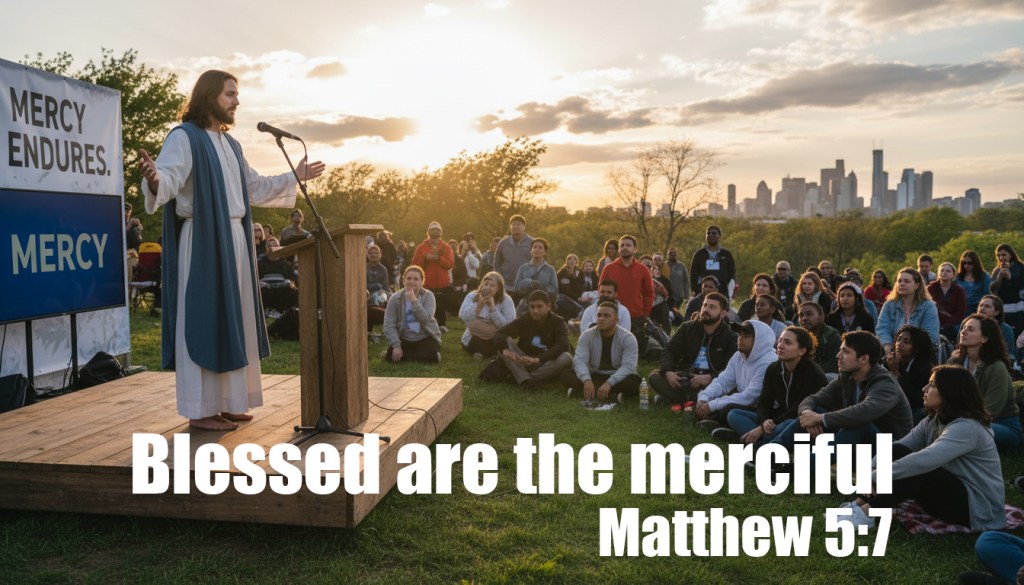
Matthew 5:7 (NIV)
4/5/26
“Blessed are the merciful,
For they shall obtain mercy.”– Jesus
Easter used to be my favorite time of year because of all the church stuff and the fact that spring was on its way. This year, I even talked Christian and Grace into coming to church. Since they will serve brunch at church, we have a short breakfast, which means a short passage this week. Grace said all week that she was bracing for church because many people at church do not share our beliefs regarding the government.
“Are you scared?” I asked.
“Not scared,” Grace said. “Just ready to be disappointed if I hear people defending Agent Orange.”
“He’s not a good Christian, is he?” I asked.
“He has weaponized Christianity,” Christian said.
“Cruelty is the point,” Grace said.
“Hate,” Christian said, “for anybody different. Disgust and hate—these are powerful tools that fascists have always deployed to bend the will of the masses.”
“Are we the masses?” I asked.
“Are you swayed by the argument that some people deserve less?” Grace said. “Do you believe that some people don’t deserve human rights?”
“No.”
“Do you want your enemies to suffer?” Grace said.
“I don’t have any enemies,” I said.
“That’s good,” Christian said. “But if you did have enemies, showing them mercy would be a great virtue, correct?”
“Jesus said merciful people will obtain mercy,” I said. “That’s the Bible verse for this week. I bet Christian nationalists don’t want that one in public schools. When did Jesus think mercy would come? See, I don’t think there’s always mercy.”
“I would agree,” Christian said. “Jesus was speaking about the kingdom that his followers thought he would establish in their lifetime.”
“Oh,” I said. “So, they didn’t get mercy until they got to Heaven?”
“Modern believers reinterpret the passage as you just did,” Christian said. “They believe that they’ll get to Heaven where they will be shown mercy…or they believe Jesus will come back one day and establish his kingdom. That’s not what Jesus’ followers believed during his lifetime.”
“Christian nationalists outright ignore this passage,” Grace said. “It doesn’t track with the behavior of their leaders or with their behavior. They believe in a gun-toting, beer-guzzling, white-supremacist Jesus.”
“For Christian nationalists, cruelty is the point, but it’s slightly more complicated than that because they are angry at the world,” Christian said. “One minute, they say they want no more wars. The next minute, they want to bomb the shit out of countries, only because their orange savior tells them that’s what they want. None of that sounds like Jesus to me.”
“Wait, I thought if you believed in Jesus, you’d get to Heaven,” I said. “John 3:16. Christian nationalists still believe in Jesus even if they sin, right?”
“The scriptures are tricky,” Christian said. “John and Paul’s theology was about faith in Jesus. In the synoptic Gospels—Matthew, Mark, and Luke—the message centers on forgiveness and atonement. The beatitudes, the words that Jesus preached through his public ministry, more specifically, are about social justice, especially in Luke.”
“I think faith is the most important part,” I said.
“I don’t,” Grace said. “Mr. Manning didn’t believe that either. Paul’s letters introduced the concept of faith in Jesus.”
“Mr. Manning didn’t believe in faith?” I asked.
“Go back and read your own books, buddy,” Christian said. “He questioned the connection between goodness and faith. People can have faith but live evil lives.”
“Faith is a matter of mental effort,” Grace said.
“Or a suspension of disbelief,” Christian said.
“Kindness and charity take work,” Grace said.
“So…which is it?” I asked.
“Belief, forgiveness, or atonement?” Christian said.
“Which one?” I asked.
“The religion of Jesus was about forgiveness and social justice,” Christian said. “The religion about Jesus was about atonement and faith.”
“They’re different?” I asked.
“Read what Jesus has to say, especially in the synoptic gospels,” Christian said. “That’s the religion of Jesus. Read what others say about him. That’s the religion about Jesus, especially what Paul says. The religion about Jesus only developed in the decades and centuries after Jesus died.”
“For our sins is why he died,” I said.
“Fair enough,” Christian said. “But pretend there is no Heaven. What’s important then?”
“The religion of Jesus,” I said.
“Show mercy,” Christian said. “That’s all Jesus is asking of you in this passage. He promises to show you mercy in return. Mercy is hard when you’re full of hate…but never impossible.”
“The problem is that the world doesn’t always work that way,” Grace said.
“The beatitudes are aspirational,” Christian said. “We should aspire to live by them.”
“So, you guys sound like you believe in Jesus,” I said.
“I believe in what Jesus was teaching here,” Grace said.
“So do I,” Christian said.
“That’s good,” I said. “There’s hope for you yet.”
In state legislatures across the country, Christian fundamentalists are passing laws meant to force the teaching of the Christian Bible in public schools. From the posting of textually inaccurate iterations of the Ten Commandments on the walls of classrooms to the incorporation of the “Trump Bible” across multiple pedagogical disciplines, these laws and mandates are sweeping the reddest parts of this nation.
The height of hypocrisy is banning books in the name of “protecting children” while mandating one particular book rife with numerous acts of sexual violence and scenes of graphic violence and genocide.
Book bans are dangerous. The Bible is worth reading and exists online and in public school libraries across the country, but proponents of mandating its formal teaching in public schools need to know what it actually says.
Some biblical themes in my books below might not be appropriate for children.









© Copyright UNBATED Productions 2026
 The JESUS Journals