
BREAKFAST BIBLE STUDY
David Predicts One of Jesus’ Last Words
Psalm 31:5 (NIV)
4/12/26
“Into your hands I commit my spirit.”
– Jesus
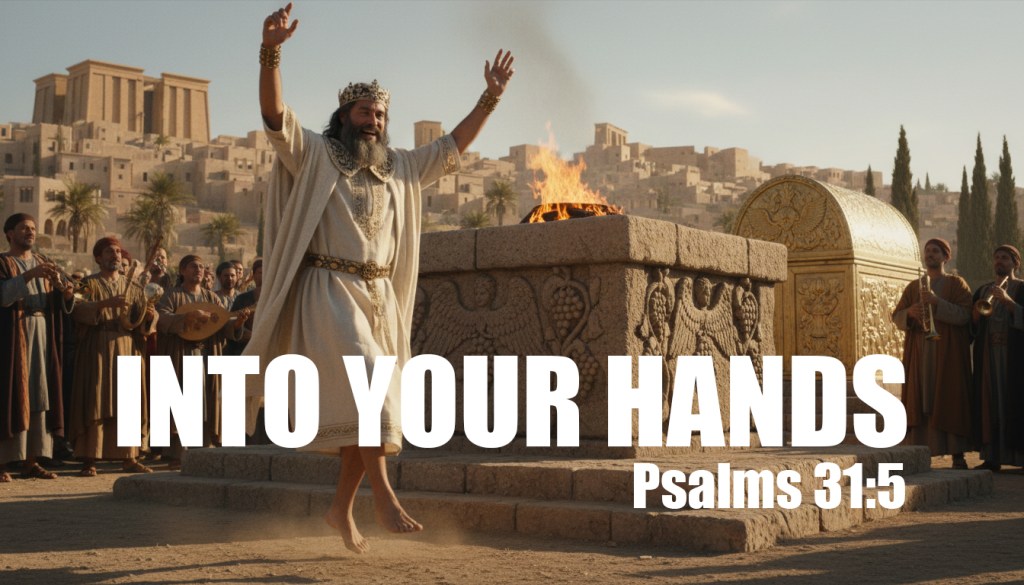
For this week’s breakfast Bible study, I had to call Pastor Mercer and ask him for some good Old Testament passages that predicted the life of Jesus. He reminded me of all the Psalms written by King David, Jesus’ ancestor, a thousand years before Jesus was born.
“You were always in church on Good Friday,” Pastor Mercer said. “Do you remember which Psalm we read every year?”
“Psalm 31!” I yelped. “That one’s perfect. It’s Jesus’ last words on the cross.”
When I told Grace and Christian what we were going to study this week, Christian just gave Grace a wink. This means they are going to try to convince me that I’m wrong. I drank two cups of coffee before breakfast to make my brain work fast enough to beat them this week.
“Psalm 31:5 has the exact last words Jesus said in Luke,” I reminded them. “How could David have predicted that if it wasn’t a prophecy?”
“Isn’t it just as possible that Jesus knew Psalm 31?” Christian asked.
“Sure, he did,” I said.
“I’ve been with people when they died,” Christian said. “I’ve heard the last words of dying men. Some of those words came from the Bible. Does that mean the Bible prophesied their deaths?”
“That’s different,” I said. “They probably knew the prayers and stuff.”
“That’s Christian’s point. Maybe Jesus knew Psalm 31,” Grace said. “Or maybe it was Luke putting words in Jesus’ mouth.”
“You always say they were putting words in Jesus’ mouth,” I said. “I don’t think that’s true. That would make them liars.”
“Luke was written long after Jesus died,” Christian said. “These accounts were passed down. That’s all we’re saying. Luke looked to the scriptures to make his case.”
“That doesn’t mean Jesus didn’t say those words,” I said.
“What’s the next passage in Psalm 31?” Christian said.
“It talks about how David hates those who cling to idols,” I said.
“What’s that have to do with Jesus?” Grace asked.
“Idolatry is bad,” I said.
“But that doesn’t really prophecy Jesus, does it?” Grace said.
“What comes before?” Christian said.
“Traps and stuff,” I said.
“It sounds like Psalm 31 is about someone living in David’s time who was struggling with affliction,” Grace said.
“Isn’t there also something about a city under siege?” Christian said.
“But that’s way later in Psalm 31.”
“Couldn’t Psalm 31 be about someone suffering in general?” Grace said, “maybe even the people of Israel suffering under the hand of their enemies?”
“It can have more than one meaning,” I said.
“Fair enough,” Christian said. “But…what were the last words of Jesus?”
“Into your hands,” I said. “You know the rest.”
“Those were his last words, according to Luke,” Christian said. “What does Mark have to say?”
“‘My God, my God, why hast thou forsaken me?’” I said.
“Same with Matthew, right?” Christian said.
“Yep.”
“And John?”
“‘It is finished.’”
“So, we have three different final statements uttered by Jesus?” Grace said.
“But they’re all important,” I said.
“If so, why didn’t Luke include Matthew and Mark’s words?” Christian said. “Why didn’t Matthew, Luke, and Mark include John’s words?”
“He could have said them all, but Matthew, Mark, Luke, and John could have run out of paper to put all the words down or something,” I said.
“Maybe,” Christian said. “But I think theology is at work, not history. John’s intent is to show Jesus’ triumph on the cross. Atonement for sins. Luke demonstrated Jesus’ reunion with God. The message is salvation. Mark and Matthew reflect on Jesus’ abandonment. They all have different theological intents.”
“But they’re all important,” I said.
“So, in the years before John was written, atonement for sin wasn’t important?” Christian said.
“Sure,” I said. “People were telling the story. It just hadn’t been written down yet.”
“All I’m saying is that these books are theological, not historical,” Christian said. “There’s a difference.”
“So…you don’t believe that Psalm 31 is prophetic?” I asked.
“I don’t,” Christian said. “And much of it doesn’t track with what Jesus experienced. One verse is cherry-picked.”
“And you don’t believe these are Jesus’ last words?” I asked.
“I don’t know,” Christian said. “He could have said all three things or none, but if you say that Jesus’ last words were ‘it is finished,’ then Matthew, Mark, and Luke have to be wrong because they put other words in Jesus’ mouth.”
“Oh,” I said.
“It can’t be all three,” Christian said. “One saying had to come last. Jesus could have said all those things, but one had to be last. I believe the gospel writers concluded the Passion narrative differently because they had different theological intentions. Do you understand?”
“Which order did it go in then?” I asked.
“I wasn’t there,” Christian said. “I’m guessing only Matthew and Mark would agree, but that’s only because Matthew was aware of Mark and borrowed from him.”
“Then Mark and Matthew would probably win the vote,” I said. “‘My God, my God, why have you forsaken me?’ That’s probably what Jesus said last, by most votes cast.”
“And probably the purest and most truthful question ever asked,” Grace said.
“That’s good, right?”
“If you believe in the resurrection, yes,” Grace said. “If you don’t, it’s beautifully sad.”
In state legislatures across the country, Christian fundamentalists are passing laws meant to force the teaching of the Christian Bible in public schools. From the posting of textually inaccurate iterations of the Ten Commandments on the walls of classrooms to the incorporation of the “Trump Bible” across multiple pedagogical disciplines, these laws and mandates are sweeping the reddest parts of this nation.
The height of hypocrisy is banning books in the name of “protecting children” while mandating one particular book rife with numerous acts of sexual violence and scenes of graphic violence and genocide.
Book bans are dangerous. The Bible is worth reading and exists online and in public school libraries across the country, but proponents of mandating its formal teaching in public schools need to know what it actually says.
Some biblical themes in my books below might not be appropriate for children.





© Copyright UNBATED Productions 2026
 The JESUS Journals