
BREAKFAST BIBLE STUDY
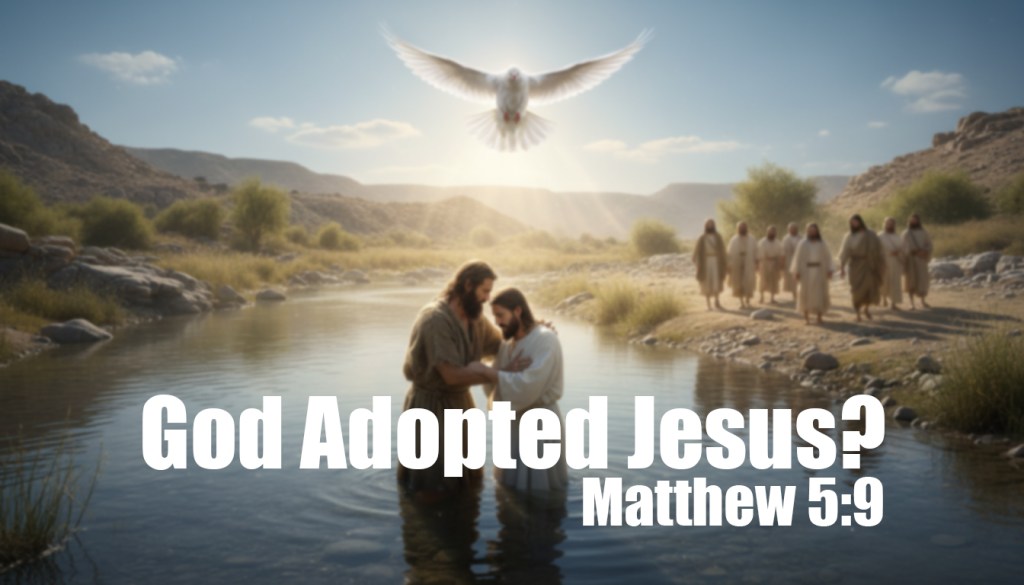
God Adopted Jesus?
Matthew 5:9 (NIV)
5/3/26
Blessed are the peacemakers,
for they shall be called sons of God.
Jesus
This week, I do not have to find a prophecy that Grace and Christian will ruin by pointing out the verse in context. Instead, we get to read beatitudes from Jesus that Christian nationalists do not like. This week, we pick the one about peacemakers.
Since Christian nationalists never want America defending other countries fighting to be free, except for when Trump bombs Iran to make gas prices double, I am not sure how Christian and Grace are going to spin this beatitude to make Christian nationalists hate it.
“Blessed are the peacemakers, for they will be children of God,” I told Christian and Grace when I came down for breakfast. “That’s the next one on the list.”
“Sons of God,” Christian said.
“Sons of God?”
“It’s the more accurate translation,” Christian said.
“Cole is right. King James reads children of God,” Grace said.
“I know it does,” Christian said. “It was deliberately translated that way, not for inclusion, but because the idea of ‘sons of God’ versus the ‘Son of God’ could cause confusion. Translators corrupted the original Greek.”
“King James translated the verses wrong from Greek?” I asked.
“He commissioned the translation,” Christian said. “But the Greek word in the earliest manuscripts is ‘huioi’, which means son by either birth or adoption.”
“Jesus was born the Son of God, but I guess God could adopt anybody,” I said.
“It’s interesting,” Christian said. “In Roman society, adoption was considered a greater honor than inheritance by blood. If someone adopted you, it made you more than a biological son.”
“I don’t get why that’s interesting,” I said.
“The Gospel of John is the first Gospel that suggests that Jesus is God incarnate,” Christian said. “If you read the synoptics, take Mark, for example, you see something like an adoption occurring during the baptism of Jesus. ‘This is my son, with whom I am well pleased.’ That’s the language of adoption in the Greco-Roman world. Modern readers don’t read it that way, but ancient Greek readers would have done so. Luke and Matthew depict nativities with a miraculous birth, certainly, but Mark, the earliest gospel writer, includes no birth narrative, and Paul only says, in Galatians, that Jesus was born of a woman. The divinity of Jesus evolved from something of an adoption, I’d say, which happened when Jesus was baptized.”
“God adopted Jesus after he was all grown up?” I asked.
“The religion evolved,” Christian said. “It still is evolving. You can see the evolution in the varying theologies of the four gospels. That’s all I’m saying.”
“I thought we were going to talk about peacemakers,” I said. “Does God adopt them?”
“That would seem to be what Jesus suggests,” Christian said.
“But not daughters,” Grace said.
“I kind of doubt it,” Christian said. “Jesus was a reformer, but this was still an ancient, misogynistic society. This was a time of peace—pax Romana—a brutal peace maintained by a brutal empire, but it was a time of peace. Jesus may be referring to civil strife and the resolution of community conflicts. He doesn’t elaborate. Women were part of Jesus’ ministry, but the word used was ‘huioi’—sons. In the ancient world, men served as peacekeepers. The Old Testament even forbade women from separating men during fights. It stands to reason that women had limited roles in peacemaking…at least in the public sphere.”
“Why would Christian nationalists get mad at this one?” I asked.
“I’m not sure they would,” Christian said. “Warriors can be called peacemakers. Peace comes when the war ends.”
“Better no war at all,” Grace said.
“Agreed,” Christian said.
“Christian nationalists stormed the Capitol,” I said. “That wasn’t peaceful.”
“No, it wasn’t,” Grace said. “But Jesus stormed the Temple. That’s how Christian nationalists might rationalize that sort of violence.”
“So…basically, people can take cherry-pickings from the Bible and make it mean whatever they want?” I asked.
“Pretty much,” Grace said, “and it’s good that you’re learning that.”
“Which is it then?” I asked.
“Which is what?” Christian said.
“Was Jesus adopted by God?” I asked.
“It might have been an easier concept to understand for Greeks during that time,” Grace said, “but most modern Christians hold to a belief in the Trinity. Most Christians believe that Jesus is one with the Father, but for the earliest Christians, this likely was a foreign concept.”
“They didn’t know about the Trinity?” I asked.
“Does the word Trinity appear in the Bible?” Christian asked.
“Nope, but I think they had another world for it,” I said, “like the Spirit or something. They kind of hide the Trinity, I think.”
“The concept of the Trinity evolved later,” Christian said, “but the idea of the Spirit being equal with the Father and Son was not something Jesus or his disciples ever mentioned.”
“So…yep…Trinity is a word never used in the Bible,” I said, “but I still think it’s true.”
In state legislatures across the country, Christian fundamentalists are passing laws meant to force the teaching of the Christian Bible in public schools. From the posting of textually inaccurate iterations of the Ten Commandments on the walls of classrooms to the incorporation of the “Trump Bible” across multiple pedagogical disciplines, these laws and mandates are sweeping the reddest parts of this nation.
The height of hypocrisy is banning books in the name of “protecting children” while mandating one particular book rife with numerous acts of sexual violence and scenes of graphic violence and genocide.
Book bans are dangerous. The Bible is worth reading and exists online and in public school libraries across the country, but proponents of mandating its formal teaching in public schools need to know what it actually says.
Some biblical themes in my books below might not be appropriate for children.









© Copyright UNBATED Productions 2026

