
BREAKFAST BIBLE STUDY
Jesus Rides a Donkey (or Two)
Zechariah 9:9; Matthew 21:1-11 (NIV)
5/10/26
Christian nationalism is just fascism cloaked in religious garb.
Grace Pecker
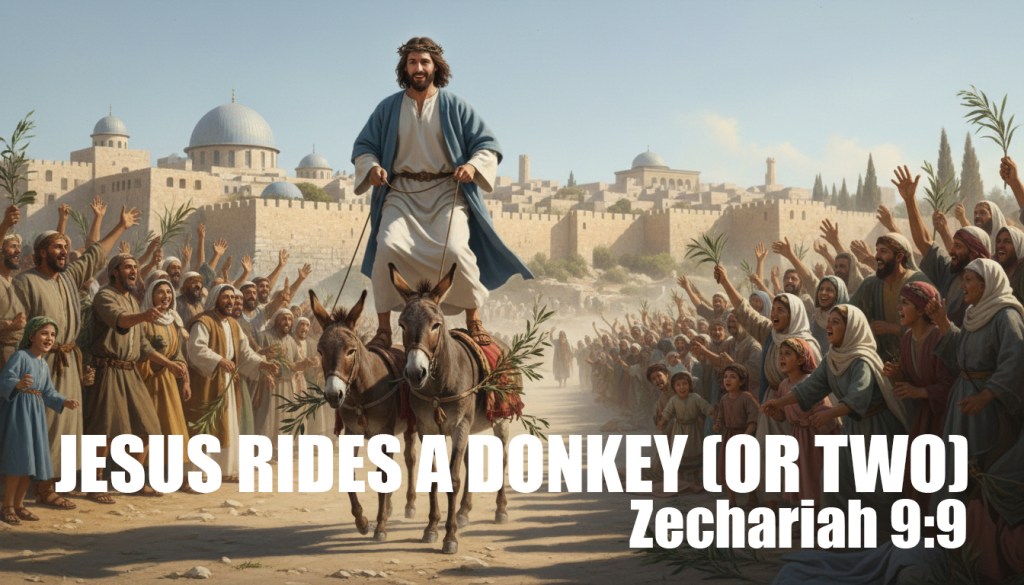
This week, I found a good Old Testament passage that points right to the King of the Jews doing exactly what Jesus did by riding a donkey into Jerusalem on Palm Sunday. The best part about the Palm Sunday story is that it happens in all four gospels. I even learned a little about Zechariah because I knew Christian and Grace would try to tell me to read the passage in context so that it wouldn’t be a prophecy. Even with all the farm work in full swing, I am finding time to learn a whole bunch of neat things. Since I am younger and Christian has a bad back, I have way more energy to do stuff like read the Bible at night. Zechariah, who wrote the eponymous book (not to be confused with an Alcoholics Anonymous book, even though it sounds somewhat similar), wrote his prophecies after the Babylonian Exile. The first part of his book is about rebuilding the Temple. The second part concerns Messianic junk about Jesus’ coming hundreds of years later.
“Zechariah?” Grace said when she came down for breakfast and saw my Bible open to Zechariah 9:9. “This is the one about the donkey?”
“Yep,” I said, “and it happens in every gospel almost the same.”
“Matthew’s version is my favorite,” Grace said.
“How come? They’re all the same.”
“Christian will fill you in,” Grace said. “Did you read all of Zechariah?”
“Pretty much,” I said. “I skimmed the stuff about the Temple.”
“Hmm,” Grace said. “What does the prophecy say?”
I read the passage to Grace: “‘Rejoice greatly, O Daughter of Zion! Shout in triumph, O Daughter of Jerusalem! See, your King comes to you, righteous and victorious, humble and riding on a donkey, on a colt, the foal of a donkey.’”
“Why a donkey?” Grace said.
“To be humble,” I said. “Warlords rode horses. A humble king would ride a donkey.”
“Common people rode donkeys,” Grace said. “Jesus was a commoner.”
“See, but mostly, Jesus just walked. He had his disciples get the donkey for him, except for the story in John. John says Jesus found the donkey, but it could be that he found it in John and then sent his disciples to fetch the donkey, like in the other accounts. In Luke, it was important to Jesus that no one rode the colt, which is the same as a donkey. Colt just means a young male foal, which is like a teenage donkey.”
“Or horse,” Grace said. “Colts can be horses, too…or guns or a cheap brand of beer.”
“Jesus didn’t drink beer or shoot guns. It was a donkey,” I said, “just like in the prophecy. In Mark and Luke, the disciples get the colt from a small town.”
“Fair enough.”
“You’re not arguing with me enough,” I said. “Are you sick or something?”
“Everything you’ve said is valid,” Grace said. “Zechariah was speaking about an earthly king who would rule Israel and bring peace, but I will concede that the gospels mostly depict Jesus as a spiritual leader. The peace promised hasn’t happened yet, but prophecies don’t really have timelines, do they?”
“Christian better come down soon,” I said. “I’m not used to winning breakfast Bible study.”
“What does Matthew say?” Grace asked. “You mentioned Luke, John, and Mark, but not Matthew. What does he say?”
“He gets it closest to the prophecy,” I said. “He gets a colt, which is the foal of a donkey. That’s how I know the colt was a donkey. Jesus rides one of them.”
“I believe he rides both of them,” Grace said, “ a colt and a donkey, mother and son.”
“Um…he does?” I asked. “How would he do that?”
“Matthew 11:7,” Grace said. “He rode them. Not it.”
“But that would be hard,” I said. “Did he ride sidesaddle?”
“I don’t know,” Grace said. “I think I know what Christian’s explanation would be.”
“Christian knows a lot about animals.”
“I think he would tell you that Matthew is misunderstanding the grammatical parallelism that Zechariah is employing. Zechariah is modifying the first word, donkey, with a prepositional phrase. He describes the donkey as a colt. He modifies the word again with an appositive, ‘the foal of a donkey’. It’s a literary device that I don’t think Matthew understood. Matthew took the poetic language too literally.”
“Um…besides the poetry junk, which did Jesus do?” I asked.
“If the event happened, Jesus might have very well ridden a donkey into Jerusalem,” Grace said, “but probably not two animals. The author of Matthew might have just screwed up because he didn’t understand the mechanics of Hebrew.”
“Oh,” I said. “So, it’s like a three-to-one vote?”
“What are we voting on?” Christian said when he finally came to breakfast.
“We’re talking about how many animals Jesus rode to fulfill the prophecy,” I said, “but we’re not voting. The four gospels are.”
“I like the picture of Jesus riding two animals at once, like a circus performer,” Christian said. “My question for you, Cole: Did Jesus know the prophecy?”
“Sure,” I said.
“So, by having his disciples find him a colt, he knew the symbolic act of riding the animal into Jerusalem might be seen as a sign.”
“Sure,” I said.
“That doesn’t sound very prophetic to me,” Christian said.
“How come?”
“Intentionally fulfilling a prophecy?” Christian said. “Sure, that could be divine intervention, but it could also be Jesus, or more likely the gospel writers, inventing a scenario that they could use to point to prophecy.”
“I don’t think they invented that,” I said.
“I bet a lot of people rode donkeys into Jerusalem,” Christian asked. “How would Jesus have stood apart from all the people coming to the Temple?”
“He was Jesus. He had disciples. He did miracles and stuff.”
“If he was so well known, how could he have moved about the city without getting caught for days, especially after taking a whip to the moneylenders?” Christian asked. “The city would have been flooded with outsiders, so, maybe, but Rome controlled that city. I’m guessing they had checkpoints.”
“You ruined it even before having your coffee,” I said.
“I didn’t mean to ruin it. These are simply historical questions I’ve always had,” Christian said. “We just don’t know the ins and outs. The problem with Zechariah 9:9 as a prophecy comes with the surrounding verses. Zechariah describes a victorious king. Jesus didn’t establish an earthly Jewish kingdom or bring universal peace to the ends of the earth. He didn’t stop any battle chariots from reaching Jerusalem. Unless you mean in a strictly spiritual sense, Jesus does not fit Zechariah’s description of the character. If Jesus is conquering sin and death with his own death and resurrection, then you might make that case in a figurative sense.”
“Wait, Zechariah doesn’t mention crucifixion,” I said.
“No, he doesn’t,” Christian said. “He was expecting a triumphant and earthly king, humble yet victorious. You could make the case that Jesus fits this description, but I don’t think Jesus was what Zechariah, or most messianic Jews of Jesus’ day, was expecting, whether he was riding one donkey or two.”
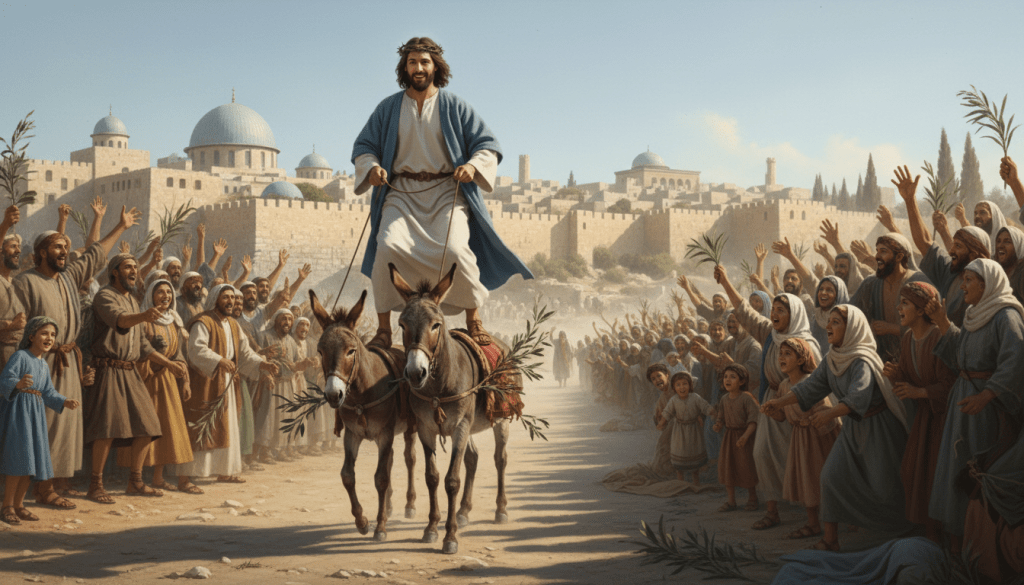
In state legislatures across the country, Christian fundamentalists are passing laws meant to force the teaching of the Christian Bible in public schools. From the posting of textually inaccurate iterations of the Ten Commandments on the walls of classrooms to the incorporation of the “Trump Bible” across multiple pedagogical disciplines, these laws and mandates are sweeping the reddest parts of this nation.
The height of hypocrisy is banning books in the name of “protecting children” while mandating one particular book rife with numerous acts of sexual violence and scenes of graphic violence and genocide.
Book bans are dangerous. The Bible is worth reading and exists online and in public school libraries across the country, but proponents of mandating its formal teaching in public schools need to know what it actually says.
Some biblical themes in my books below might not be appropriate for children.







© Copyright UNBATED Productions 2026

