
BREAKFAST BIBLE STUDY
Woe to the Rich
Luke 6:24 (NIV)
5/31/26
But woe to you who are rich,
for you have already received your comfort.
Jesus
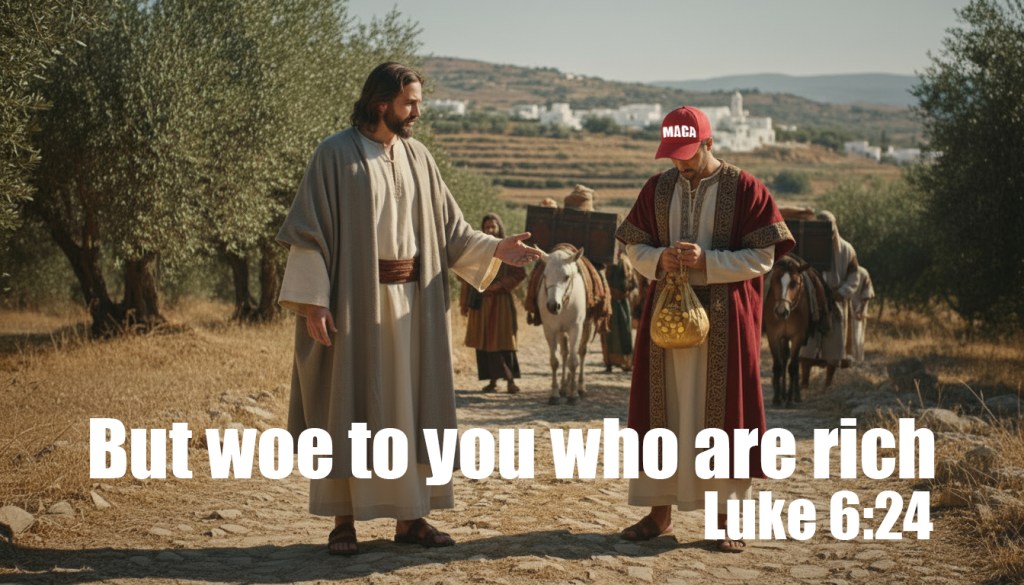
My brother, Christian, always frets about money when we get too much or too little rain. We have plenty of savings, but too many bad crops could leave us bankrupt. Grace thinks global warming might just bankrupt us, even with drought-resistant crops, because the cost of research and seed development would add to our inputs. I thought Trump’s tariffs hurt us most, but the war he is losing with Iran has made fertilizer and fuel costs skyrocket. I do not worry about what I cannot control. I pray for the right amount of rain, but I also plan to ensure we can make changes on the farm or in our finances to weather these problems. I am not smart about the Bible or school junk, but Mr. Alexander taught me everything about farming after Dad died. I remind Christian and Grace that we are still pretty rich by the end of every season, yet they both claim we are frugal.
That is why this week’s breakfast Bible study kind of scared me. I knew all of Jesus’ beatitudes, but I never understood his woes. In Luke 6, Jesus gives all his blessings first, then follows with the woes, but in Matthew, Jesus saves his woes for an entirely different chapter. In Matthew, he calls all the Pharisees a bunch of vipers. In Luke, Jesus makes his woes pretty clear. In the first woe, Jesus curses rich people, which, as I mentioned, now kind of scares me.
“We live comfortably,” I said. “Does that mean we won’t get into Heaven?”
“Your sister and I are the wrong people to ask,” Christian said.
“Because you don’t believe in Heaven?”
“Do you take from the poor to make your money?” Grace asked.
“I farm.”
“Do you try to help the poor?” Christian asked.
“Just like Dad,” I said, “but Jesus told me that as long as there was hunger and suffering, I had work to do.”
“When did he tell you that?” Christian asked.
“When I was in jail before I time-traveled,” I said.
“So…Jesus told you this in a vision,” Christian said, “in your alternate timeline?”
“Yep, and Jesus also told that one young, rich man to give everything he owned to the poor,” I said. “That was in Mark. He said that thing about the eye of a camel, and with God, anything is possible. The second part is the best part about it because of miracles and stuff.”
“A camel through the eye of a needle,” Grace said.
“That one,” I said.
“A lot to unpack, isn’t it?” Christian said. “Jesus probably believed that a new kingdom was coming. Jesus also suggested that hope was not lost for the young man because with God, all things are possible. Had the rich man done as asked, he would have become poor. Had he given away some of his money, he would have been able to keep making money and donating more money.”
“Like we do?”
“Correct,” Christian said. “We do what’s pragmatic.”
“Oh,” I said.
“Greed, I believe, is the good Lord’s concern,” Grace said. “At least, that’s how many preachers interpret the message.”
“Oh.”
“You’re not greedy,” Christian said.
“Trump and his billionaire friends are greedy,” I said.
“They fit the bill,” Grace said.
“So, they won’t get into Heaven?” I asked.
“Woe to the rich,” Christian said.
“Oh,” I said. “Unless they give away all their wealth.”
“Fat chance of that,” Grace said. “There are billionaires who are trying to give away all they have before they die. They’re the ones giving back.”
“So…we like this passage?” I asked.
“We do, but don’t go giving away all your money,” Grace said. “If you do, we won’t have money for next year’s crops.”
“Takes money to make money,” Christian said. “With money, you can do good.”
“Oh, so for farmers like me, giving away all my money at once would hurt people in the long term,” I said. “I guess we shouldn’t plan that the world is coming to an end because that probably won’t happen. I mean, the historical Jesus thought the world was going to be a new kingdom, but if the historical Jesus knew better, maybe he would have been pragmatic, which would have helped more people.”
Grace gasped a little.
“What?” I asked. “A spider?”
“You just referenced an historical Jesus,” Christian said. “I think you just shocked your sister with that turn of phrase.”
“And made me a little sad,” she said.
In state legislatures across the country, Christian fundamentalists are passing laws meant to force the teaching of the Christian Bible in public schools. From the posting of textually inaccurate iterations of the Ten Commandments on the walls of classrooms to the incorporation of the “Trump Bible” across multiple pedagogical disciplines, these laws and mandates are sweeping the reddest parts of this nation.
The height of hypocrisy is banning books in the name of “protecting children” while mandating one particular book rife with numerous acts of sexual violence and scenes of graphic violence and genocide.
Book bans are dangerous. The Bible is worth reading and exists online and in public school libraries across the country, but proponents of mandating its formal teaching in public schools need to know what it actually says.
Some of the biblical themes in the books below might not be appropriate for children.








© Copyright UNBATED Productions 2026

