
BREAKFAST BIBLE STUDY
Thirty Pieces of Silver
Zechariah 11:12-13 (NIV)
6/7/26
What you are about to do, do quickly.
Jesus
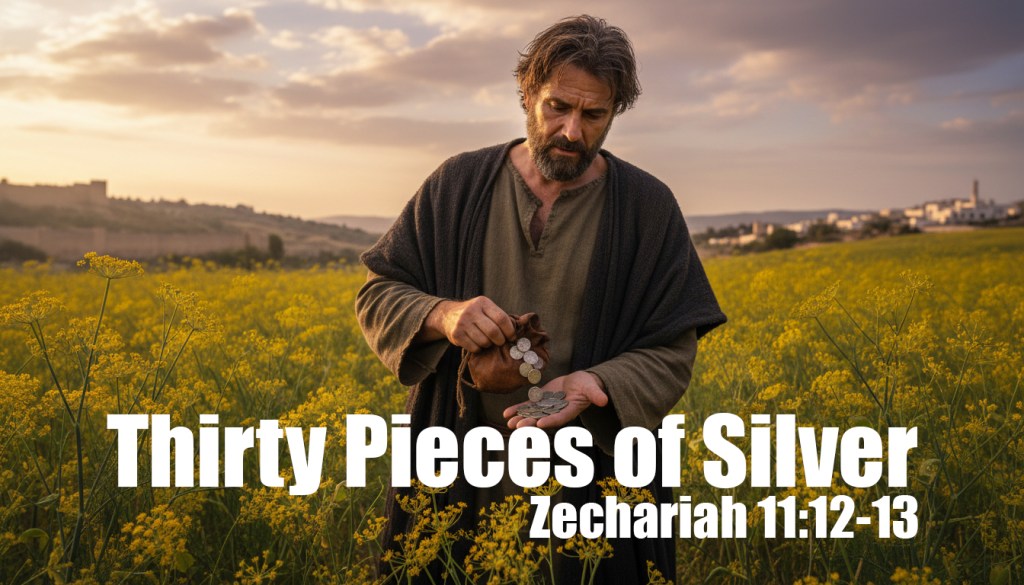
Throughout my upbringing in church, we were taught that the Old Testament was filled with prophecies predicting the coming of Jesus. However, every time I find one of these prophecies, Christian and Grace figure out why it isn’t prophetic. This time, I found a good one. It’s about those thirty pieces of silver. See, if Jesus had been betrayed for twenty, forty, or some other number of pieces of silver, the prophecy would never have come true. However, Judas received thirty pieces of silver for betraying Jesus, which he threw back into the Temple, just as the prophecy foretold.
“Zechariah, huh?” Christian said when he saw my opened Bible. “You’re going through the greatest hits.”
“It was thirty pieces of silver, not twenty-nine or fourteen or any other number,” I said. “How did Zechariah guess that?”
“Maybe Matthew made up the number,” Christian said.
“How would you know?”
“I don’t,” Christian said. “Did you read Zechariah in context?”
“Should we wait for Grace?” I asked.
“Let her sleep in,” Christian said.
“I didn’t get Zechariah in context,” I said. “It’s about burning fields and breaking staffs and stuff. The New Testament doesn’t say that Judas did any of that, but he could have, couldn’t he?”
“I believe Zechariah is speaking on behalf of God and himself as God’s prophet,” Christian said. “Zechariah is breaking the staffs. God is burning the fields.”
“How come?”
“He’s not happy with his people,” Christian said.
“And Judas takes the thirty pieces of silver,” I said. “That’s the prophecy.”
“Where does Zechariah mention Judas?” Christian said.
“Um,” I said. “The numbers add up. Thirty pieces of silver.”
“That’s it? Okay, I guess, but did you know that when Matthew cites Old Testament prophecy, he wrongly attributes Zechariah to Jeremiah?”
“I know about that,” I said. “It was probably a copyist error.”
“The Hebrew names were similar,” Christian said.
“You don’t believe the prophecy is about Judas, do you?” I said.
“Zechariah 11 is about breaking covenants,” Christian said. “If you want to cherry-pick two verses and claim the shepherd is Judas and not God or Zechariah, that’s fine, but the prophecy seems to fall apart in the context of the entire chapter. Just like all Old Testament prophecy, you need to squint a bit to make the prophecy fit the life of Jesus.”
“But the numbers are the same,” I said.
“Did Matthew count out the coins?” Christian said.
“Maybe.”
“The deal was between Judas and the priests,” Christian said. “Judas betrays Jesus, feels guilty, returns the money, and hangs himself, correct?”
“Yep.”
“Who did he tell about the transaction in the meantime?” Christian said.
“What do you mean?”
“It was a secret deal to betray Jesus,” Christian said. “Whom did he tell?”
“Matthew?”
“C’mon, Cole,” Christian said.
“God inspired it?” I asked.
“Then why didn’t God correct Matthew about the attribution to Zechariah?”
“It was a copyist error?”
“Why didn’t Paul ever mention Judas?” Christian said. “Paul knew several of Jesus’ disciples. None of them mentioned Judas to Paul? Or…maybe they did, but Paul didn’t think Judas was relevant? Paul is the writer writing closest to the time of Jesus by a generation. He writes the first written accounts of Jesus.”
“Wait, didn’t he mention Judas when he said Jesus was handed over?” I asked.
“Read Paul’s letters yourself,” Christian said. “Judas is not mentioned by name. Sure, Paul’s letters are primarily instructional. He’s not writing a biography of Jesus. But I still think it’s strange that Judas appears in all four gospels, but not in one of Paul’s letters.”
“Maybe Paul wanted to skip that part because he was sad about persecuting early Christians,” I said. “See, he might have felt he was a bit of a betrayer, too.”
“That’s like saying Jesus was so disgusted by homosexuality and abortion that he couldn’t bring himself to mention those things,” Christian said.
“Really?”
“Not really.”
“Wait. I know there were gay people. The Bible talks about that. But did they have abortions outside the Temple back then?” I asked. “I know about the abortion ritual in the book of Numbers. We talked about that, but Jesus didn’t mention abortions, did he? So…maybe it wasn’t a thing by the time he was around.”
“Silphium was an herb touted as a contraceptive and abortifacient,” Christian said. “It went extinct. Nero, who lived after Jesus, was gifted the last plant. Likely, the plant was harvested to extinction because it was so popular. The plant was so popular that it appeared on coins. Jesus likely had heard of it.”
“Wait, maybe Paul wrote about Judas in those lost letters…and that silliest plant. Maybe Paul said people shouldn’t use that silliest plant.”
“Maybe Paul did write about Silphium, but where’s the evidence of that?” Christian said.
“I guess there is none,” I said.
“Exactly. I tend to believe that when stories become more elaborate over time, they should be questioned. Based on Paul’s letters, which are the earliest accounts we have of Jesus, Paul seems to know very little about Jesus’ life. Mark knows a little bit more. Mark’s gospel appeared several decades after Paul’s seven undisputed letters. Matthew, Luke, and John get far more elaborate, but that elaboration creates contradictions. I don’t believe historical accuracy was the intent. I believe they were inventing story elements like the nativity and Judas’s betrayal.”
“I don’t believe that.”
“I know you don’t,” Christian said. “But consider this: does memory get better as time passes?”
“Worse, mostly,” I said.
“So, if a story gets more elaborate as time passes,” Christian asked, “would you consider that story to be getting more accurate or not?”
“Maybe with the Bible, it gets more accurate, because God was inspiring it,” I said.
“Adding details as questions emerged?” Christian asked.
“Yep,” I said.
“And basing those details on what?” Christian asked.
In state legislatures across the country, Christian fundamentalists are passing laws meant to force the teaching of the Christian Bible in public schools. From the posting of textually inaccurate iterations of the Ten Commandments on the walls of classrooms to the incorporation of the “Trump Bible” across multiple pedagogical disciplines, these laws and mandates are sweeping the reddest parts of this nation.
The height of hypocrisy is banning books in the name of “protecting children” while mandating one particular book rife with numerous acts of sexual violence and scenes of graphic violence and genocide.
Book bans are dangerous. The Bible is worth reading and exists online and in public school libraries across the country, but proponents of mandating its formal teaching in public schools need to know what it actually says.
Some of the biblical themes in the books below might not be appropriate for children.







© Copyright UNBATED Productions 2026

