
BREAKFAST BIBLE STUDY
Prophesied by a Messenger?
Mark 1:1-8, Malachi 3:1, Isaiah 40:3 (NIV)
6/21/26
“Did you read the prophecy in context?”
Christian Pecker
This week, after almost a year and a half of breakfast Bible study, I noticed something neat about prophecies while searching the Bible online. See, some paper Bibles have footnotes to help me find prophecies, but the online Bible has hyperlinks that pop up and show me where to go and what stuff means. This week, when I looked up Mark to find a prophecy, I found those notes. The first note in Mark 1:1 states that the word Christ means the “Anointed One.” I always just thought Christ was his last name…or what people said when they swore his name. The second note in Mark 1:1 says that some early manuscripts omit the phrase “Son of God.” I guess this means Christian is right about the Bible having different versions and stuff.
This week, I planned to remind Christian and Grace that the Bible contains numerous prophecies about John the Baptist, who would announce the arrival of Jesus. In the second verse of Mark, I found my first prophecy, which leads me to Malachi 3:1. Since I know that Christian and Grace will have me read the prophecies in context, which means reading all the surrounding verses, I attempt to do this with Malachi and become confused. See, Mark says that God will send a messenger ahead to prepare the way for Jesus. Malachi says that God will send a messenger, who will prepare the way for him before he suddenly appears in some temple. I am not sure if Jesus ever did this, but he did frequently visit temples. The punctuation confuses me because I am not sure if the messenger and the Lord are the same person.
“It would be helpful if the messenger or Lord were called the Messiah or Jesus,” I said. “I don’t know which is which in Malachi.”
The messenger or Lord does something weird with God’s people, like refining them with soap to make them like silver, which must be a metaphor, because I cannot remember Jesus doing that, unless this meant he performed miracles and forgave sins and junk. Malachi also has a trial for sorcerers, adulterers, perjurers, and people who cheat workers of wages, and people who hurt widows, orphans, and foreigners.
“Oh, wait,” I said. “I don’t remember Jesus doing any of that stuff, but I bet if he came back, Trump and all his junk drawer people would be in a whole bunch of trouble.”
I am not sure how Malachi prophesies John the Baptist and Jesus exactly, but I like the part about putting Trump and his junk drawer people on trial for all the bad stuff they do, such as kidnapping people, bombing schools for girls, and covering up sex crimes of bad people.
Since Jesus and John the Baptist came about 400 years after Malachi, I am guessing Malachi probably could not have guessed the names of John and Jesus and had to use metaphors for what he thought they looked like.
The next note, found in Mark 1:3, refers to John the Baptist preparing the way for the Lord, a concept that originates in Isaiah 40:3, written approximately 700 years before the time of Jesus and John the Baptist. I am not sure whether John the Baptist straightened any paths because he was so busy baptizing to forgive sins, but this is probably another one of those metaphors I do not understand.
In Isaiah 40, God pays Jerusalem twice as much for all her sins for some reason. I am guessing this is because of some punishment or something.
Back then, God did a whole lot of punishing.
I become even more confused when I read that Isaiah might not have written anything after Isaiah 39. Since Christian always talks about what scholars say, I found out that scholars believe the last part of Isaiah was not written until after the Babylonian exile, when Isaiah was already dead.
If Isaiah never wrote Isaiah 40, I wonder if this can still be considered a prophecy by Isaiah, since it’s essentially a lie that Isaiah wrote that chapter.
I suppose scribes pretending to be Isaiah could also be good at prophesying, even though they probably should have put their own names on their homework.
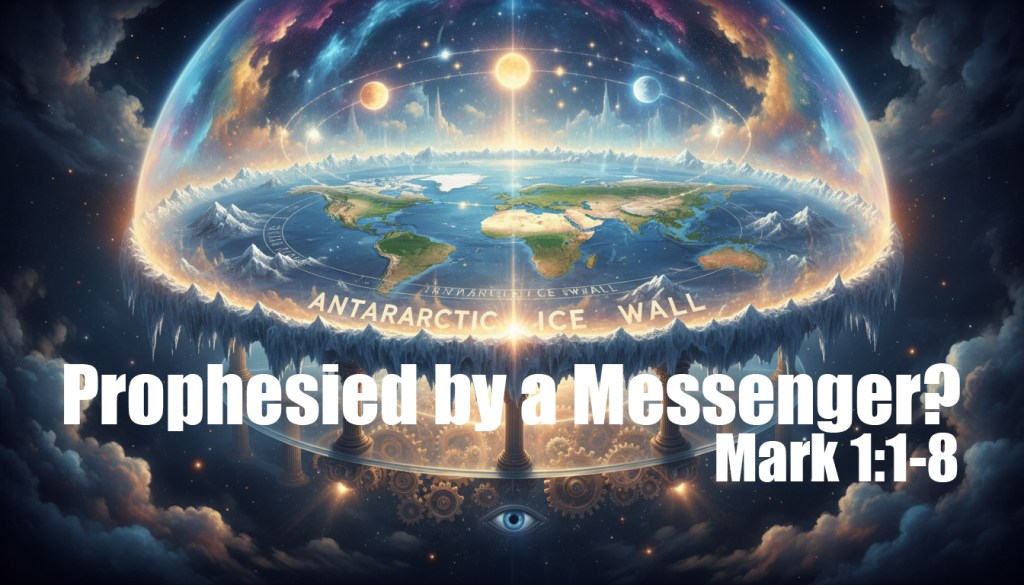
Since I am supposed to read the prophecies in context, I read about how all these mountains will fall and all these valleys will rise, which would make everything flat.
This must be more metaphor.
If the verses were literal, then Jesus would have had to make everything flat. I am pretty sure they did not have bulldozers back then, so making everything flat would have taken a lot of work. Maybe if Jesus had his disciples helping with shovels, he could have flattened things, but that would have taken a long time to make Israel flat as a pancake.
The whole point of everything being flat is so that everybody in the world can see the glory of God, so I am not even sure Jesus could have done this with all the bulldozers in the world.
The other problem is that the world is not flat. I know that if I could see across the whole world for miles and miles, I would never see to China…unless I dug a hole. But the Bible says nothing about that.
“Um,” I said when I got tired of making sense of all the prophecies about Jesus and John making the world flat so that everybody could see God all at once. “Why couldn’t the prophets just say that Jesus was coming and that John the Baptist would announce him. It’s all metaphors and stuff. I don’t get metaphors. I once thought they were word spices for smart people because I didn’t know that a synonym wasn’t cinnamon. The prophecies say nothing about baptisms or about Jesus dying on the cross and rising from the dead. It leaves out all the important stuff. How would the Jewish people have known that Jesus was coming if the prophecies weren’t very specific? Oh, wait, now I get what Christian and Grace keep talking about. I can make it a prophecy about Jesus and John the Baptist if I want, but someone else could say it’s talking about something else.”
“Cole,” Christian called from his bedroom. “Are you talking to yourself?”
“I think we can skip breakfast Bible study this week,” I told him. “You’d probably be right about this one, even though I would probably tell you that you’re wrong.”
“That’s a little vague,” Christian said.
“That’s what I was just telling the prophecies,” I said. “They weren’t specific at all. They talk about making everything flat, which I don’t think is possible because the world is a giant ball. For breakfast, we can do something else this week. You both need a break.”

In state legislatures across the country, Christian fundamentalists are passing laws meant to force the teaching of the Christian Bible in public schools. From the posting of textually inaccurate iterations of the Ten Commandments on the walls of classrooms to the incorporation of the “Trump Bible” across multiple pedagogical disciplines, these laws and mandates are sweeping the reddest parts of this nation.
The height of hypocrisy is banning books in the name of “protecting children” while mandating one particular book rife with numerous acts of sexual violence and scenes of graphic violence and genocide.
Book bans are dangerous. The Bible is worth reading and exists online and in public school libraries across the country, but proponents of mandating its formal teaching in public schools need to know what it actually says.
Some of the biblical themes in the books below might not be appropriate for children.







© Copyright UNBATED Productions 2026

