
BREAKFAST BIBLE STUDY
Woe to Laughers
Luke 6:25 (NIV)
6/28/26
“Woe to you who laugh now, for you shall mourn and weep.”
Jesus
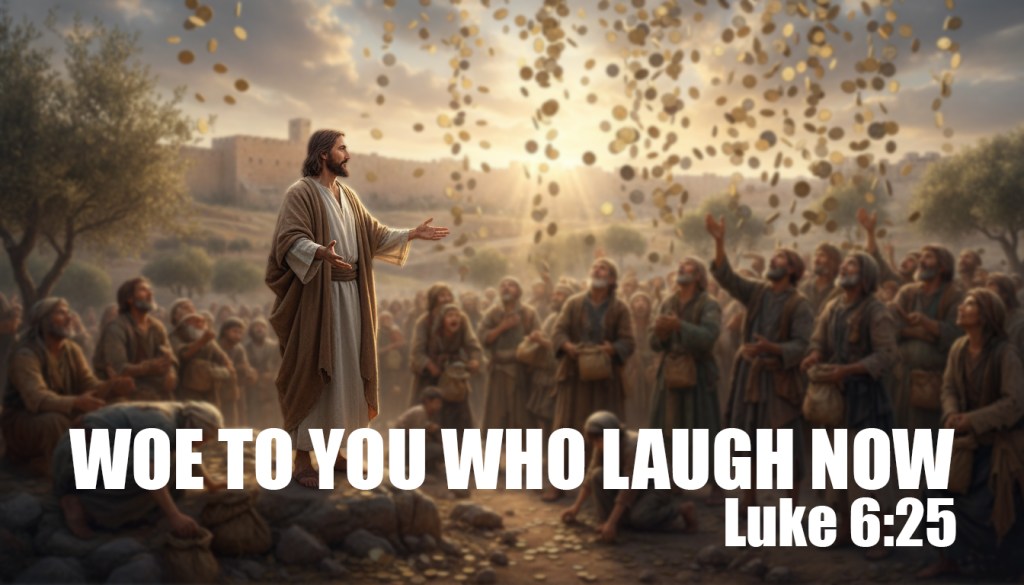
Since it is late June and the crops are doing well, Grace and Christian can focus on their projects. Christian works on his physical therapy to get his back strong again. Grace focuses on her protests, which have grown larger since Trump went crazy against the Constitution. This leaves me time to work in the fields and think about how Trump’s tariffs have worsened our crop prices, and how the government stopped buying surplus food that Americans cannot eat and that farmers cannot sell. This surplus food went to help poor people around the world so that they would not hate America so much for all its warfare and greed. Trump and that Egon Must guy ruined all that because they thought it would make them more money, even though USAID was only a tiny sliver of the American budget. Grace says that people like Egon Must and Trump find their cruelty funny. Grace says she’s not sure she believes in God, but she sure seems to follow a lot of what Jesus says in his beatitudes, which is why I’m happy about this week’s breakfast Bible study, which covers a woe that I think I understand.
“If you understand the passage,” Christian asked me when he started the coffee, “why do we need to discuss it?”
“Because I like how you and Grace make the Bible make better sense for me with your better words of explanation,” I said.
“The beatitudes and woes in Luke encapsulate Jesus’ view on the reversal of fortune he believes will occur between the poor and weak in the kingdom of God,” Christian said. “This is the religion of Jesus, not the religion about Jesus.”
“See, words like that,” I said. “I would never think of ‘reversal of fortune.’ What does that mean?”
“Just what it sounds like,” Christian said. “The rich become poor. The poor become rich. Those who laugh will mourn and vice versa.”
“Isn’t that one about being greedy?” I asked. “What about the laughing part?”
“If you are rich, you have reason to laugh,” Christian said. “If you are poor, you have reason to mourn. That’s not the only reason people laugh or cry, but it fits with Jesus’ overall theme of wealth inequality.”
“So, it’s okay to be rich and laugh, but not at the expense of others, maybe?” I asked.
“That’s a good way of renegotiating the text, and most readers assume as much,” Christian said, “but it’s not what the text says. If the text is taken at face value, the poor become wealthy, and the wealthy become poor. Laughers mourn. Mourners laugh. Simple reversal of fortune. Period. That’s a problem for Christians who are not suffering. At some point, we all mourn, which Jesus would have known, so I am pretty sure he is talking about people’s overall plight, not fleeting emotions.”
“We’re not poor,” I said. “So, in the kingdom, we will be poor, right?”
“Yes,” Grace said as she came to the kitchen for her cup of coffee. “Dirt poor.”
“And dirt poor people will be rich?” I asked. “That doesn’t sound terrible.”
“It’s not a message people of means want to hear,” Christian said. “Notice how Christian nationalists want the Ten Commandments posted in schools?”
“We talked about that all last year,” I said.
“Ever wonder why they don’t make the same case for the beatitudes and woes?”
“They don’t?”
“Have you ever heard about anybody wanting those posted in public schools?” Christian asked. “Maybe some people do, but nobody is lobbying for that.”
“I believe Jesus’ message flies in the face of American capitalism,” Grace said. “That’s a real problem for most Americans. That’s why they lean on Paul’s teachings about salvation.”
“But Jesus and Paul taught the same thing,” I said.
“No, they didn’t,” Christian said. “The religion of Jesus, who preached the beatitudes and woes, was different than the religion about Jesus, which dealt with faith in the death and resurrection of Jesus.”
“So, Jesus didn’t want people to be rich?” I asked.
“He promised a reversal of fortune for those who were poor and oppressed,” Grace said.
“Christian just said that smart thing, too!” I said. “See what I mean, Christian?”
“What smart thing?” Grace asked.
“Reversal of fortune,” I said. “So, will we be poor in Heaven?”
“Good question,” Christian said. “I’m worried about life here on Earth.”
“So…how do churches deal with the woes and stuff, especially the rich ones?” I asked.
“Churches get around the beatitudes and woes, heck, even Matthew got around Luke, by adding meaning where none was intended. His beatitudes were more spiritual than temporal.”
“See how you make it all smarter for me?” I asked.
“What is he talking about?” Grace asked.
“Word choice,” Christian said. “The message Jesus preached was simple. People renegotiate and reinterpret his words to live with the choices they make.”
“Like how?”
“Prosperity gospel,” Grace said, “which preaches that Jesus wants Christians to be rich. In most cases, however, the only people getting rich in these churches are the preachers.”
“Jesus told the rich young man to give away all his wealth,” Christian said. “That flies in the face of the prosperity gospel.”
“But wasn’t Jesus on a timeline in that story?” I asked. “To follow him, the young man had to give away everything to the poor.”
“That’s another age-old renegotiation of Jesus’ message,” Grace said.
“Jesus preached the immediacy of a coming kingdom,” Christian said, “but that kingdom hasn’t come, not here on Earth, so in theory, we should all give away all our wealth.”
“If I do that, I wouldn’t be able to buy seed for next year’s crop,” I said.
“We know,” Grace said. “It’s an impractical command, and some Christians will tell you that Jesus was being deliberate about that.”
“How come?”
“They’d say nobody can live up to the law, meaning everybody needs Jesus,” Grace said, “even rich people who might not otherwise sin.”
“Camel through the eye of a needle,” Christian said.
“Yep, but God can make anything possible,” I said. “That’s in Matthew, Mark, and Luke. Except in Matthew, Jesus adds that his apostles will have thrones to rule over the twelve tribes.”
“Look at you differentiating the gospels,” Christian said.
“The camel part and God’s power are unifying messages,” I said, “except it’s not in John.”
“Indeed,” Christian said, “For the rich young man who appears in the synoptic gospels, that meant giving all he owned to the poor. We don’t know if the rich young man was greedy, but he certainly wasn’t willing to give away all his wealth. Is protecting what you have greed?”
“It’s certainly not charity,” Grace said.
“Donald Trump really doesn’t live up to Jesus,” I said. “He’s all about greed. He likes to hurt poor people, just like that Egon Must guy, who makes the electric cars, and rockets, and junk like that.”
“Yet, most Christians adore Trump and admire Elon Musk,” Grace said.
“How can you adore Trump and worship Jesus?” I asked. “That makes no sense. Jesus preached against all the things Trump and Egon do.”
“That’s a great question,” Christian said.
“Hypocrisy would be my answer,” Grace said.
In state legislatures across the country, Christian fundamentalists are passing laws meant to force the teaching of the Christian Bible in public schools. From the posting of textually inaccurate iterations of the Ten Commandments on the walls of classrooms to the incorporation of the “Trump Bible” across multiple pedagogical disciplines, these laws and mandates are sweeping the reddest parts of this nation.
The height of hypocrisy is banning books in the name of “protecting children” while mandating one particular book rife with numerous acts of sexual violence and scenes of graphic violence and genocide.
Book bans are dangerous. The Bible is worth reading and exists online and in public school libraries across the country, but proponents of mandating its formal teaching in public schools need to know what it actually says.
Some of the biblical themes in the books below might not be appropriate for children.








© Copyright UNBATED Productions 2026

