
A Whale Did NOT Swallow Jonah
Jonah 1:17 (NIV)
9/13/26
“Isn’t it troubling how Christian love has dovetailed so effortlessly with MAGA hate?”
Grace Pecker
Because we are so busy this time of year and because I am journaling my adventures again, I failed to find a good prophecy this week, so I worked from memory instead.
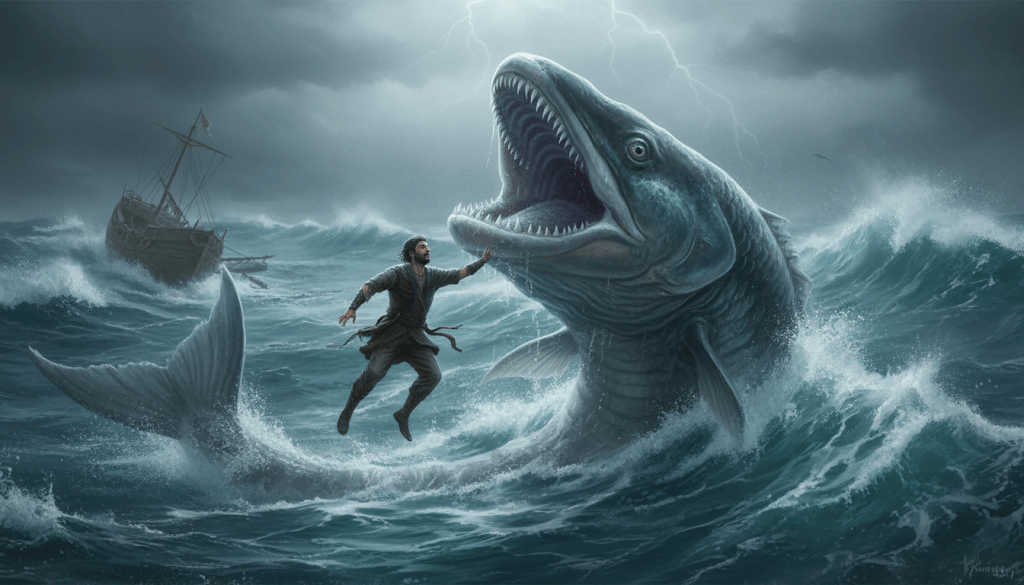
This week, I chose a story I remembered from Sunday school—Jonah and the Whale. The passage is short: “Now the Lord provided a huge fish to swallow Jonah, and Jonah was in the belly of the fish three days and three nights.”
I should have begun with this passage months ago, because Jesus predicts that he will be buried for three days, just like Jonah, whom the whale swallowed. On the other hand, I’m not sure that Jonah died when he was swallowed because he was praying inside the belly of the whale. Jesus died. Jonah did not, I don’t think, because I’ve never heard of people praying after they die.
In any case, the metaphor still makes a good prophecy.
“Jonah was in the whale for three days,” I told Christian and Grace at breakfast. “Just like Jesus was in the tomb for three days. How do you explain that?”
“The Bible calls it a great fish,” Christian said, “not whale. Whales are mammals.”
“See, fish don’t get as big as whales, and it’s still a prophecy that predicted Jesus would lie in the tomb for three days and three nights before rising from the dead,” I said.
“Only it wasn’t three days and three nights,” Christian said. “The crucifixion occurred on a Friday, or possibly Thursday, depending on which Gospel you believe. If it’s Friday, that means Jesus died on Friday and was buried that same day. So, that’s part of Friday, Friday night, Saturday, Saturday night, and then he rose on Sunday morning. At most, that’s two partial days, one full day, and two nights. If you’re measuring by the hour he went into the tomb until the hour he rose, he was in that tomb for less than two days.”
“Not if he was crucified on Thursday,” I said. “That makes three nights, three days.”
“That’s only according to John, who doesn’t mention Jonah,” Christian said. “In the synoptic gospels, Jesus compares himself Jonah, but your days don’t add up, unless the Gospel writers counted days differently than we do.”
“Is it because they used Roman numerals?” I asked.
“I doubt it,” Christian said.
“The Gospel writers made an interesting literary conceit,” Grace said. “I believe it was only Matthew and Luke who made that connection to Jonah.”
“What’s that word?” I asked.
“What’s what word?” Grace asked.
“Conceited literature,” I said. “I don’t know what that is.”
“A literary conceit is when a writer compares two unrelated things,” Grace said.
“They are related,” I said. “Jesus was in the tomb for three days just like Jonah was in the fish for three days.”
“Okay, that, by definition, is a literary conceit,” Grace said, “which the Gospel writers used to create something of a prophecy, even though they were writing after Jesus died. My guess is they were putting words in Jesus’ mouth.”
“That’s not my guess,” I said.
“So, let’s compare the two events,” Christian said. “Jonah runs from God because he doesn’t want to preach against Nineveh. He boards a ship. Storms toss the ship. The crew casts lots, which is a form of divination. The lot falls on Jonah. He asks to be thrown overboard. The crew doesn’t want to anger God by killing one of his people, but the storm grows worse, so they toss Jonah overboard. A great fish comes along. Jonah prays in the belly of the fish. After three days, the fish vomits him onto shore rather ingloriously. Do you think that all really happened, Cole?”
“It’s in the Bible,” I said.
“Even many church leaders throughout history questioned the story’s historicity,” Grace said. “It reads like an allegory or parable, which Jesus used all the time.”
“Some church leaders read antisemitism into the story,” Christian said.
“How?” I asked.
“Jonah is angry with God for sparing Nineveh,” Christian said.
“Why is that antisemitic?” I asked.
“Good question,” Grace said. “Jonah questions the will of God, like Jews questioned Jesus. That’s why Jesus talks about a wicked generation wanting signs and only getting the sign of Jonah.”
“That doesn’t sound like something Jesus woudl say,” I said.
“Really?” Christian asked. “Then why did Matthew’s Jesus say those words?”
“So, wait, Jesus was an antisemite?” I asked. “That doesn’t sound right.”
“It can’t be right considering that Jesus was a Jew, preaching among his people, while wholy immersed in the Jewish world,” Grace said.
“But back to the comparison to Jonah,” Christian said. “Was Jesus ever angry with God or running from God? Was he praying in the tomb? Did the tomb vomit Jesus up?”
“No,” I said. “God forgave Nineveh. That sounds like Jesus.”
“Ninevah atoned,” Christian said.
“And that made Jonah angry?” I asked.
“And he gets chastised by God,” Grace said. “Remember the plant at the end. It protects Jonah from the sun one day. A worm eats it the next day. Jonah is not happy.”
“That’s at the end,” I said. “God said he cared for the people of Ninevah because they are more important than the plant that protected Jonah.”
“Right,” Christian said. “This is a post-exilic story, written in Aramaic, with many post-exilic elements, featuring a figure mentioned briefly earlier in the Bible, written by a pretty open-minded person, willing to believe that gentiles could atone.”
“Wait, Jonah was somewhere else in the Bible?” I asked.
“In 2 Kings, I think,” Grace said. “Nobody knows if Jonah from 2 Kings is the same Jonah of the eponymous book.”
“Eponymous?” I asked. “I thought Jonah put his name on the Book of Jonah. Yeah, he did. See. Look at my Bible. It’s right in the title. We know who wrote it—Jonah.”
“That’s not what eponymous means,” Christian said. “You’re thinking of anonymous. And, I believe much of Jonah is written in the third person throughout the text, so it wouldn’t make sense that Jonah was the author. The author is unknown.”
“So, it is anonymous,” I said. “So, wait, why did the fish swallow Jonah?”
“Jonah is running from God,” Christian said. “His boatmates cast him overboard to still a storm. That’s why the fish swallowed him. The Jonah story is an allegory full of allegorical elements. It served as a wonderful conceit for Matthew, but I’m not sure that anybody would have made the connection between Jonah and Jesus before Matthew did. Jesus didn’t stay in the tomb for three full days, according to Matthew. He was raised on the third day, but he had only been in the tomb for perhaps a day and a half. Maybe Jesus did preach about Jonah and predicted his death and resurrection, but more likely, someone made the connection to Jonah after Jesus died.”
“So, you do believe Jesus rose from the dead?” I asked.
“I’m just pointing out the comparison,” Christian said. “There is more evidence that Jesus rose from the dead than that Jonah got swallowed by a fish…because Jesus likely did exist. Is that fair enough for you?”
“It’s still a good story,” I said.
“Had someone written down Jesus’ sermons while he was alive,” Grace said, “if scribes had recorded his words before his death, if those documents existed, I would, indeed, believe that Jesus predicted his own Crucifixion. Even then, I would still only consider Jonah to be a literary conceit. Unfortunately, the earliest writings about Jesus only date back to Paul, who wrote at least a decade after Jesus’ death. Stories about Jesus circulated orally for years, but we don’t know anybody who’s reporting on Jesus during his life.”
“What do you mean? Of course we don’t know anybody who was reporting on Jesus’ life. Nobody we know was alive back then,” I said. “That was, like, thousands of years ago.”
“No, Cole, not people that we personally know,” Grace said. “Scholars have not found writings about Jesus that date to the time Jesus was alive. All known writings come many years after the fact.”
“I wish somebody would find those documents written while Jesus was alive,” I said. “Maybe they could look harder. Sometimes, people hide the things they write if they think they’re going to get in trouble. I hid my journals. Dad hid the Pecker Family Bible for a long time. Have the scholars looked for those old writings from the time Jesus was alive?”
“Like the Dead Sea Scrolls?” Christian asked. “Yes, people are always digging for the past, especially in that part of the world.”
In state legislatures across the country, Christian fundamentalists are passing laws meant to force the teaching of the Christian Bible in public schools. From the posting of textually inaccurate iterations of the Ten Commandments on the walls of classrooms to the incorporation of the “Trump Bible” across multiple pedagogical disciplines, these laws and mandates are sweeping the reddest parts of this nation.
The height of hypocrisy is banning books in the name of “protecting children” while mandating one particular book rife with numerous acts of sexual violence and scenes of graphic violence and genocide.
Book bans are dangerous. The Bible is worth reading and exists online and in public school libraries across the country, but proponents of mandating its formal teaching in public schools need to know what it actually says.
Like the Bible, some biblical themes in the books below might not be appropriate for children.









© Copyright UNBATED Productions 2026
 The JESUS Journals