
Gideon Fights for Jesus
Judges 6-8 (NIV)
9/20/26
“Isn’t it troubling how Christian love has dovetailed so effortlessly with MAGA hate?”
Grace Pecker
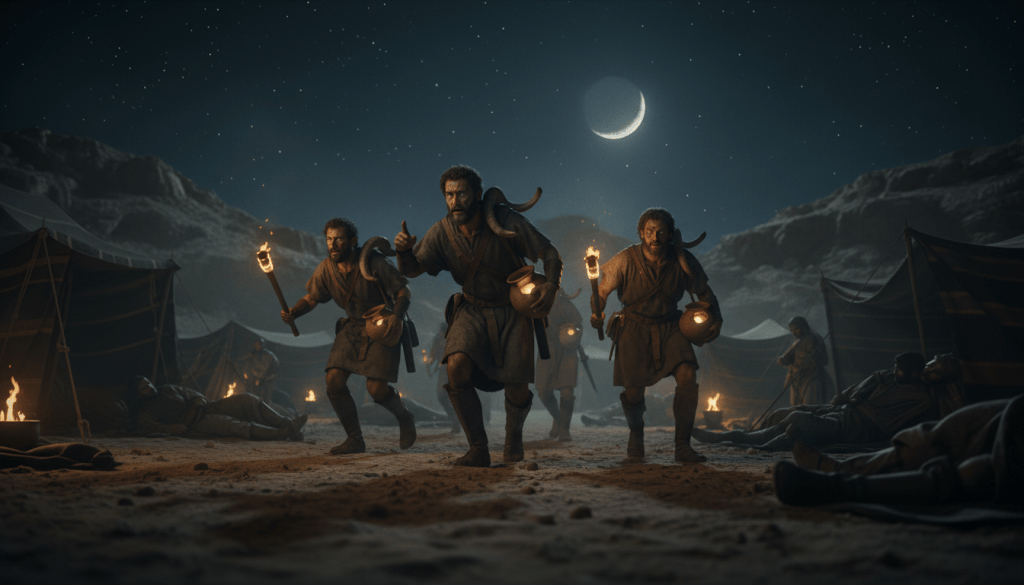
This week, I wanted to get Christian on my side again about Christophanies. Since Christian was a Navy SEAL, I know he can relate to war stories. Gideon was one of the most elite warriors in the book of Judges. God had him cut his forces down to only three hundred before fighting the Midianites. They used jars to cover their torches and blew trumpets to scare the Midianites, but I wanted to focus on how the angel of the Lord first appeared to Gideon. See, Gideon was just a boy working for his father and hiding grain in a winepress when Jesus came and sat under an oak tree, telling Gideon that he would be a warrior. Gideon never really trusted that it was the angel of the Lord until he offered a sacrifice. Jesus touched the sacrifice with his staff and then shot up to Heaven in the smoke. Gideon was scared, but Jesus told him that he would not die. If Gideon had seen God the Father, he would probably have died, but with Jesus, he was safer. Even though the Book of Judges calls Jesus the angel of the Lord, he does stuff that Jesus would have done, like carrying a staff and sitting under a tree. A regular angel probably would have just floated in the sky. See, the angel’s wings might have gotten stuck if he tried to sit under a tree.
“That’s your argument?” Christian asked when I explained all that at breakfast Bible study. “The angel’s wings would have gotten stuck under the tree?”
“It makes perfect sense,” I said.
“Angels floating in the sky?” Christian asked. “Like on a Hallmark greeting card?”
“Not like that, because the angel of the Lord looked like a man,” I said, “just like Jesus, probably.”
“Jesus is commanding Gideon to go to war?” Grace asked.
“Even though the Israelites were doing bad things like marrying Canaanites and worshiping Baal, Jesus still wanted to save them,” I said.
“Why not just turn the Midianites away with a storm?” Grace asked.
“I’m not sure,” I said. “I think God wanted judges to help Israel way back then.”
“Could it be that writers much later are taking figures that are part of the collective conscious and ascribing divine intervention to their acts?” Christian asked.
“I don’t think so,” I said, “probably because I don’t know what you mean.”
“The Book of Judges was likely written by the Deuteronomist in the southern Kingdom of Judah, long after David,” Christian said, “maybe in the seven to six hundred years before Christ, likely during the reign of Josiah.”
“How do you know?” I asked.
“That Judges wasn’t a contemporary account?” Christian asked. “Stories in Judges often lead with the phrase ‘in that day’ or something along those lines. That phrase right there suggests the writer is writing about the past.”
“The story of Gideon likely came from oral tradition,” Grace said.
“That doesn’t mean it’s not true,” I said.
“Wait. So, Gideon was commissioned by Jesus to go to battle,” Grace said. “Would the Prince of Peace ask Gideon to wage war against his neighbors?”
“I forgot about that part,” I said. “Maybe preincarnate Jesus was just an angel after all.”
“These are nation-building stories, Cole,” Christian said. “The whole point is that Gideon was outnumbered but reduced his forces to three hundred in spite of overwhelming odds. Greece had a similar story, based on fact, that came later. Three hundred against a Persian army. The goal of that story was similar to the story of Gideon, to encourage bravery. The Spartans used the Hot Gates to slow down Xerxes. Gideon used trumpets and torches to turn an army against itself. Gideon is a war hero from the past meant to encourage a small nation to survive ongoing threats.”
“See, but Gideon had God,” I said. “Maybe the angel wasn’t Jesus, but God helped Gideon.”
“Squeezing Jesus into these stories creates a moral dilemma for you,” Grace said, “but that’s okay if it allows you to read these stories as the authors intended. These authors were likely court scribes, attempting to create a mythic past to lend legitimacy to the people and their king. Does that make sense?”
“Yep, God can inspire scribes just like he inspires prophets and gospel writers,” I said, “even if it was just an angel helping Gideon in this story.”
In state legislatures across the country, Christian fundamentalists are passing laws meant to force the teaching of the Christian Bible in public schools. From the posting of textually inaccurate iterations of the Ten Commandments on the walls of classrooms to the incorporation of the “Trump Bible” across multiple pedagogical disciplines, these laws and mandates are sweeping the reddest parts of this nation.
The height of hypocrisy is banning books in the name of “protecting children” while mandating one particular book rife with numerous acts of sexual violence and scenes of graphic violence and genocide.
Book bans are dangerous. The Bible is worth reading and exists online and in public school libraries across the country, but proponents of mandating its formal teaching in public schools need to know what it actually says.
Some of the biblical themes in the books below might not be appropriate for children.







© Copyright UNBATED Productions 2026

