
The Scepter Departed
Genesis 49:10 (NIV)
8/30/26
“Christian nationalism is about power, nothing more.”
Christian Pecker
Since school has just started again, we need to be careful of the bus when we are taking the farm equipment across the road. This week, the bus broke down right near our farm, so Christian and I had to take some of the kids home in our truck on Friday afternoon. Some of the parents came by to thank us, and one of them brought a ham-and-egg hot dish, which we saved for this week’s breakfast Bible study, meaning nobody needed to cook this morning…except for heating up the dish and making coffee. Sometimes, good things like that happen, which makes Grace like the Four Corners a little bit more, even though she had it tough growing up here. Because I did not have much time to study the Bible this week, due to farm work and bussing those kids, I went online to find a popular prophecy about Jesus, which is using my resources and not cheating, according to Grace.
On one web page, the Old Testament passage had about six different New Testament references, which meant it must have been good, even though I did not understand it many of the explanations.
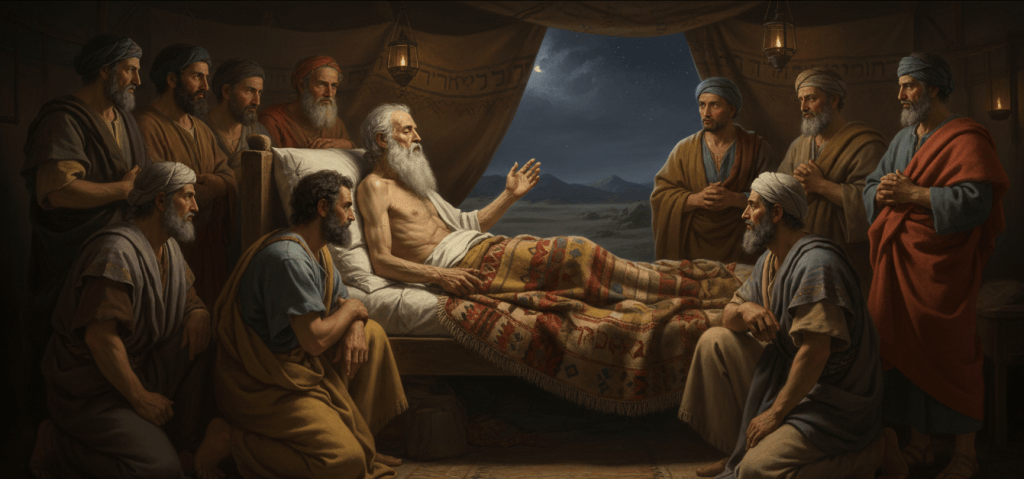
The passage was from Genesis. In the chapter, Jacob is about to die, so he tells all his sons what will become of them and their ancestors, offering blessings and curses to each one of them.
(Noah, another ancestor of Jesus, did the same thing with his sons when he was drunk and naked in his tent and made Canaan slaves to Israel.)
Just as Noah prophesied blessings and curses, Jacob predicted that good things would happen to some of his sons and bad things would happen to the others.
Those sons made up the twelve tribes of Israel, plus Levi, who never had land because his people became priests…and made money from the other tribes with blood redeeming and junk like that. The prophecy about Jesus is also about Judah and how he becomes a nation. The prophecy reads:
The scepter will not depart from Judah,
nor the ruler’s staff from between his feet,
until he to whom it belongs shall come
and the obedience of the nations shall be his.
Genesis 49:10
Since I don’t know much about the other tribes and their prophecies, I write the Judah prophecy down on scratch paper, hoping Grace and Christian won’t force me to read the rest of the chapter for context…because they always show me how the prophecies never come true. When Christian sees my scratch paper, but no Bible in my lap, he goes to his room to get his Bible…because he’ll want to do context.
“This prophecy was true when it was written, but it was false by the time Jesus came on the scene,” Christian said. “Judah fell to the Babylonians. The scepter did depart from Judah for centuries. Before that, Judah was a vassal state to various parties. Davidic rule, which is what the prophecy is about, ended not long after it began. This ‘prophecy’ wasn’t written by Moses. It was written when the nation of Judah was ascendant. In other words, this prophecy is simply nation-building propaganda. It has nothing to do with Jesus.”
“You made it too hard already,” I said, and then I decided that I would just tell Christian and Grace what the verse is actually about. “This is about Jacob telling Judah what would happen to his progeny in the future, which includes Jesus, who becomes king in Heaven and brings all the nations together. That’s what it really means.”
“Most Jews don’t see it that way,” Grace said. “And nobody with one eye open would think that Jesus brought all the nations together. Most of the world is not Christian. Most Christians don’t even follow the teachings of Jesus.”
“Yet,” I said.
“The other problem is the translation issue,” Christian said. “A better translation from the New Revised Standard Version editions is:
“The scepter shall not depart from Judah,
nor the ruler’s staff from between his feet,
until tribute comes to him,
and the obedience of the peoples is his.”
“I didn’t have time to read the annotation notes about the language,” I said.
“As the Hebrew language evolved, the meaning of part of this passage was lost,” Christian said. “We don’t know what the part about tribute meant when it was written. The Hebrew word is Shiloh, which is translated in multiple ways.”
“Isn’t Messiah one of them?” I asked because I did read those annotation notes.
“That’s a convenient translation for Christians,” Christian said, “but that translation poses logic problems.”
“How can we claim this passage is prophetic when we can’t even be sure of what it means?” Grace asked.
“It means Jesus descended from Judah,” I said. “He’s the Messiah.”
“Okay,” Christian said, “but were all those ancestors of Jesus holding Judah’s scepter up until the time Jesus was born? That’s what the passage would imply.”
“They could have been in secret,” I said.
“While in exile?” Grace asked.
“Maybe.”
“While they were slaves?” Christian asked.
“Maybe not,” I said.
“You can claim Christ’s mercy endures forever,” Grace said. “That’s not a provable claim. You can’t claim that the tribe of Judah ruled Israel up to the time of Jesus. The scepter did depart from Judah long before Jesus was born. ”
“Why not?” I asked.
“The Bible itself claims that Judah was defeated,” Christian said. “We know from the Bible about this. The prophecy is false.”
“Are you sure?” I asked. “You can’t say that Christ’s mercy doesn’t endure. How can you prove that?”
“Christ’s mercy is something you feel in your heart,” Grace said. “We know from the Bible, as well as from outside sources, that Judea fell to Babylon and the Davidic line was broken.”
“You don’t even believe Jacob or Judah existed,” I said.
“These mythic figures might have been based on some reality,” Christian said, “but as stories are passed down, embellishment can happen. The tribe of Judah did rule for generations, so there is that…but Abrahamic stories are just nation building myths…myths written contemporaneous to those nations.”
“See, when you say it’s a myth, you’re saying God didn’t inspire it,” I said.
“Maybe God inspires myth,” Grace said. “How about that?”
“Why would God do that?” I asked.
“Can’t God do anything?” Christian asked.
“Jacob’s sons were figureheads of tribes that likely existed,” Grace said. “Founding fathers. Many ancient cultures had figures like this.”
“Romulus and Remus founded Rome,” Christian said. “If they did exist in some form, I highly doubt wolves suckled them. People have been reaching into mythic pasts for millennia. The United States even created myths around its Founders.”
“Jesus wasn’t a part of the United States,” I said. “I know he was way earlier.”
“George Washington chopping down his father’s tree was a myth,” Grace said.
“Really?” I asked.
“Attempts to create accurate histories only occurred in the past few centuries,” Christian said. “Myths resonate because they are fantastical and hit upon universal themes.”
“History, on the other hand, can be kind of dry and unthematic,” Grace said.
“Agree to disagree…once I look up a bunch of words that you said,” I said.
In state legislatures across the country, Christian fundamentalists are passing laws meant to force the teaching of the Christian Bible in public schools. From the posting of textually inaccurate iterations of the Ten Commandments on the walls of classrooms to the incorporation of the “Trump Bible” across multiple pedagogical disciplines, these laws and mandates are sweeping the reddest parts of this nation.
The height of hypocrisy is banning books in the name of “protecting children” while mandating one particular book rife with numerous acts of sexual violence and scenes of graphic violence and genocide.
Book bans are dangerous. The Bible is worth reading and exists online and in public school libraries across the country, but proponents of mandating its formal teaching in public schools need to know what it actually says.
Some of the biblical themes in the books below might not be appropriate for children.









© Copyright UNBATED Productions 2026

