
Jacob Wrestled Jesus
Genesis 32:22-31 (NIV)
8/9/26
“Christian nationalism is about power, nothing more.”
Christian Pecker
This week, I learned some new words when looking for more theophanies in the Bible. A special kind of theophany involving Jesus is called a Christophany. The word cuts off “theo” for God and sticks on “Christ” for Jesus. I also learned preincarnate. Jesus was God incarnate, which means he was God in the flesh. When Jesus appeared in the Old Testament, he was preincarnate, meaning he appeared to the patriarchs in the olden times like a ghost or an angel or something. I also learned the word patriarch. That’s just the men of olden times.
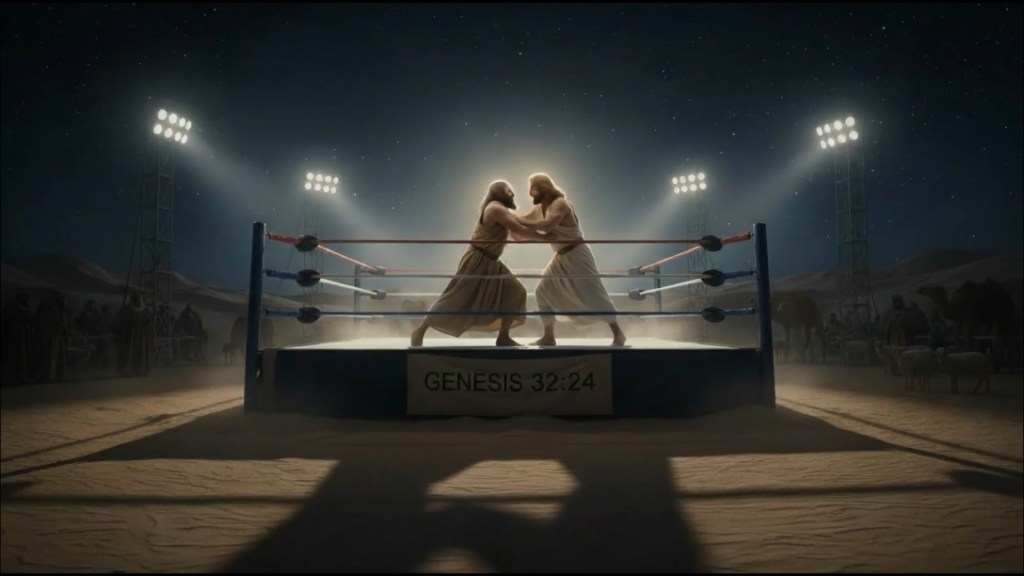
Christian always liked the story of Jacob wrestling the angel of God when we were little because it involved fighting. The Internet told me that the angel of God was really Jesus, but I do not know how to prove any of that to Christian and Grace, because Jacob thought that the wrestling match was with a man at first. Jacob wanted to wrestle the man to get a blessing for some reason. And at the end of the fight, Jesus tells Jacob that his name will be changed to Israel because he fought God and man. The El in Israel means God. The “Isra” part in Israel must mean to fight.
“Your breakfast is getting cold,” Christian called up to me as I put the final touches on my notes. “Chop-chop, we have work to do today.”
“Almost ready!” I said. “I have notes about Jacob and Jesus!”
“The wrestling match?” Christian called.
“They wrestled all night,” I said. “Could you do that?”
“No,” Christian said. “Certainly not with an angel…not that I’ve seen proof of angels.”
“No,” I said as I took my seat. “It’s okay not to believe in angels because the angel was Jesus. He was in man form. That’s how we know he was Jesus.”
“Couldn’t angels take human form?” Grace asked.
“Um,” I said. “Did they use that one word for when they came with a message?”
“Malak?” Christian said. “Messenger. I believe Hosea uses the word to describe the being Jacob wrestled, but Genesis uses the word ‘Ish,’ which means man.”
“It was an angel or a man?” I asked.
“Genesis uses the word man,” Christian said. “Hosea uses the word malak. If we just look at Genesis, we’re dealing with a man who claims he is a divine being.”
“Who is Jesus,” I said.
“Did this angel or man name himself?” Grace asked.
“He renamed Jacob,” I said.
“But he didn’t identify himself as Jesus?” Grace said.
“He was preincarnate,” I said.
“That’s the Christian interpretation,” Grace said.
“Yep.”
“Why was Jesus wrestling Jacob?” Grace asked.
“To keep him from running from his brother?” I asked.
“Not a bad analysis,” Christian said.
“Why did Jesus resort to physicality?” Grace said. “Was Jesus known for wrestling? Did the angel of the Lord wrestle anybody else in the Old Testament?”
“I don’t know,” I said. “What does the story mean if it’s not about Jesus?”
“Superficially, the story gives us the meaning behind place names and the reason why Israelites wouldn’t eat certain parts of an animal.”
“The hip,” I said, “because Jesus wounded Jacob’s hip and made him limp.”
“That doesn’t sound very Christian of Jesus,” Grace said.
“Why is Grace ruining this?” I asked Christian, who usually ruins breakfast Bible study with his logic and reasoning.
“I just think the violence sounds out of character for Jesus,” Grace said.
“If this episode was a test for Jacob,” Christian said, “the story has a deeper meaning symbolically. Jacob was a bit of a trickster. He was running from his brother, whom he had tricked. God…or an angel…or Jesus stopped him. After that, Jacob came out limping and faced his brother, humbled. A limp tends to humble a man. The limp is a physical manifestation of his inner growth.”
“So…was the angel-man Jesus?” I asked.
“Christians would say yes,” Grace said. “Jews would say no. Scholars would say some of these stories might have emerged from the Proto-Semitic polytheistic traditions of the northern region of Israel, where Jacobi cults emerged. That’s opposed to the Abrahamic monotheistic cults that emerged in the southern region. I’m probably oversimplifying a plethora of archaeological findings and the Documentary Hypothesis, but were talking about a religion that evolved over centuries and millennia…and we have work to do today.”
“So…how do I prove it was Jesus that wrestled Jacob?” I asked.
“You really can’t,” Christian said. “It comes down to interpretation. Jacob encountered a divine being in human form. That’s what the text suggests, nothing more. Centuries later, after Christianity was founded, Christians theorized that the being Jacob wrestled was a preincarnate Jesus.”
“So, Cole, what would have people thought before Christianity?” Grace asked.
“That it was an angel or something?” I asked.
“So…if this was written long before Jesus was alive, what was the author’s intent?” Christian asked.
“That it was Jesus wrestling Jacob and God who inspired Moses to write it down?” I asked.
“That’s what modern Christians believe, not ancient Israelites,” Grace said.
“Oh,” I said. “So…people wouldn’t have figured it out until Jesus came along?”
“Ancient Israelites probably understood the wrestling match as a man finally growing up,” Christian said. “Jacob had dreams and visions, but he also toiled to achieve success. This episode might have been a defining moment in Jacob’s life and an important foundational myth for Israel. Christians made it about Jesus, when an angelic figure or a god in the ancient pantheon of northern Israel serves the story just as well.”
“So…you don’t believe Jacob wrestled Jesus?” I asked.
“I doubt Jacob even existed,” Christian said.
In state legislatures across the country, Christian fundamentalists are passing laws meant to force the teaching of the Christian Bible in public schools. From the posting of textually inaccurate iterations of the Ten Commandments on the walls of classrooms to the incorporation of the “Trump Bible” across multiple pedagogical disciplines, these laws and mandates are sweeping the reddest parts of this nation.
The height of hypocrisy is banning books in the name of “protecting children” while mandating one particular book rife with numerous acts of sexual violence and scenes of graphic violence and genocide.
Book bans are dangerous. The Bible is worth reading and exists online and in public school libraries across the country, but proponents of mandating its formal teaching in public schools need to know what it actually says.
Some of the biblical themes in the books below might not be appropriate for children.







© Copyright UNBATED Productions 2026

