
Jesus and Manoah
Judges 13 (NIV)
8/23/26
“Christian nationalism is about power, nothing more.”
Christian Pecker
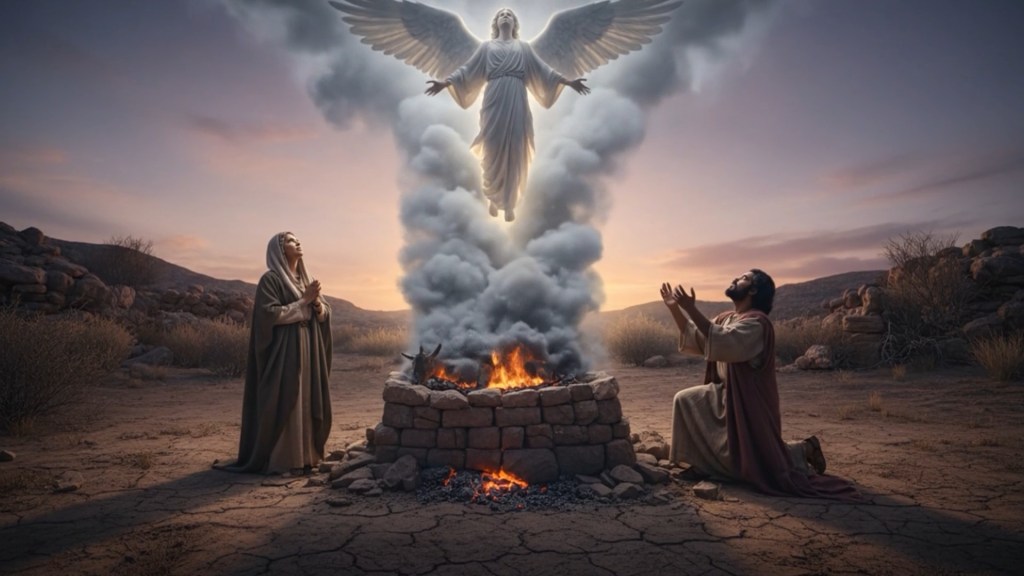
Since I know that my brother, Christian, liked the story of Samson when we were growing up, I thought this week would be a good week to bring up the Christophany that announced Samson’s birth to Manoah and his wife.
See, Manoah’s wife was barren until a man of God who looked like an angel of God came to her and then to Manoah, telling them they would have an important child and that they had to follow all sorts of rules for him. When Monoah sacrificed a goat for the angel of God, whose name was beyond Manoah’s understanding, the angel rose in the flames and went back to Heaven.
“I thought we covered Samson last year,” Christian said when he saw my Bible opened to Judges 13. “We discussed him being a morally questionable pre-figure of Christ.”
“We’re not doing Samson,” I said. “We’re doing the angel that came to Manoah.”
“You think the messenger was a preincarnate Jesus?” Grace asked.
“Yep.”
“How so?” Christian asked.
“A bunch of the angels that came to announce stuff were really Jesus,” I said.
“That’s a popular Christian interpretation,” Christian said.
“That doesn’t mean it’s wrong,” I said.
“What was the angel’s name?” Grace asked.
“Too hard to pronounce or something,” I said. “He gave Manoah and his wife a bunch of instructions to make Samson a Nazarite.”
“What was Manoah’s wife’s name?” Grace asked.
“I don’t remember,” I said.
“Was she named?” Grace asked.
“Probably not.”
“So, not important enough to earn a name?” Grace asked.
“Samson was important. She was Samson’s mom,” I said.
“Manoah’s wife was just an incubator for Samson?” Grace asked.
“But Jesus appeared to her, and she probably helped raise Samson, following all those rules and stuff,” I said.
“Did Jesus always appear to people who were going to give birth to important people?” Christian asked.
“They had to be really important,” I said.
“Who announced Jesus to Mary?” Christian said.
“Gabriel,” I said. “He came to announce Daniel and John the Baptist, too. I guess people could pronounce Gabriel’s name when the later Bible times came around.”
“Gabriel’s name means God is great,” Christian said. “All names that end with ‘El’ invoke God. Michael and Gabriel are the only named angels in the Bible. These angels were invented during the Persian period, after the Jewish captivity in Babylon. These angels battled demons. Demons were invented in those later times to explain injustice. The concept was heavily influenced by Greek and Persian cosmology. Stepping back several hundred years, angels weren’t named during the period when earlier scribes compiled the book of Judges. This would have been long before the Babylonian captivity. Angels had no names. Demons did not exist. At least, they didn’t exist as we understand them. Back then, evil spirits came directly from God.”
“That can’t be right. Jesus cast out demons, which never came from God,” I said.
“Before any of that happened, people avoided invoking God’s name,” Christian said. “The second commandment is proof of that. God’s name was powerful. Invoking it could bring wrath. We see that power on display with the Ark of the Covenant, which contained the power of God. Even in this story, notice the fear that the angel invokes in Manoah’s wife? They’ve seen a heavenly being, which makes her think they are going to die. All power, good or evil, came from the gods. Are you following what I’m saying?”
“Jesus wouldn’t kill Samson’s parents,” I said. “The angel was Jesus.”
“You’re not following me,” Christian said.
“That’s becuse you’re all over the map, Christian,” Grace said. “Let me try.”
“Have at it,” Christian said.
“Okay, Cole, you say the angel is Jesus, but is Jesus’ name too wonderful or difficult to pronounce?”
“I can pronounce it,” I said.
“This angel had a name that he refused to tell Manoah and his wife because they would not be able to pronounce it,” Grace said. “It stands to reason that this is a name other than Jesus and that this angel is not Jesus.”
“The angel is meant to be mysterious and supernatural,” Christian said.
“Oh,” I said. “It kind of sounds like Gabriel coming to Mary, only Mary didn’t sacrifice a goat or anything. Gabriel wasn’t Jesus. Was it Gabriel who came to Monoah and his wife?”
“Can you pronounce Gabriel?” Grace said. “Look, in hindsight, Christians link the angelic figure in this story to Jesus, but in doing so, they ignore clues counter to their theology.”
“Like the angel’s name being too hard to pronounce?” I asked.
“Christians make a connection that practicing Jews might dismiss,” Grace said.
“I can only guess that the Samson tradition was either found in the Book of Jasher or incorporated into the Hebrew Bible from other regional myths,” Christian said. “It probably evolved from earlier Canaanite stories. It could only evolve so much after Christianity developed, without scholars spotting the changes. Reinterpretation is the only way you can change the story now.”
“The ancient redaction people made annotations or something, I bet,” I said. “Notes in the margins would show what they needed to change. That’s how you guys helped me rewrite my books. You put notes in the margin.”
“That’s not exactly how redaction worked back then,” Christian said. “The good news is that we have ancient versions of the Old Testament that predate Christianity by hundreds of years.”
“Upstairs or something with the Pecker Family Bible?” I asked.
“By us, I mean the world. The Dead Sea Scrolls,” Christian said. “The Septuagint. These texts help modern scholars immensely by providing a snapshot in time, allowing scholars to spot any subsequent redaction or reinterpretation in later versions of the same text. Does that make sense?”
“Um…so who was the angel again?” I asked.
In state legislatures across the country, Christian fundamentalists are passing laws meant to force the teaching of the Christian Bible in public schools. From the posting of textually inaccurate iterations of the Ten Commandments on the walls of classrooms to the incorporation of the “Trump Bible” across multiple pedagogical disciplines, these laws and mandates are sweeping the reddest parts of this nation.
The height of hypocrisy is banning books in the name of “protecting children” while mandating one particular book rife with numerous acts of sexual violence and scenes of graphic violence and genocide.
Book bans are dangerous. The Bible is worth reading and exists online and in public school libraries across the country, but proponents of mandating its formal teaching in public schools need to know what it actually says.
Some of the biblical themes in the books below might not be appropriate for children.








© Copyright UNBATED Productions 2026

