
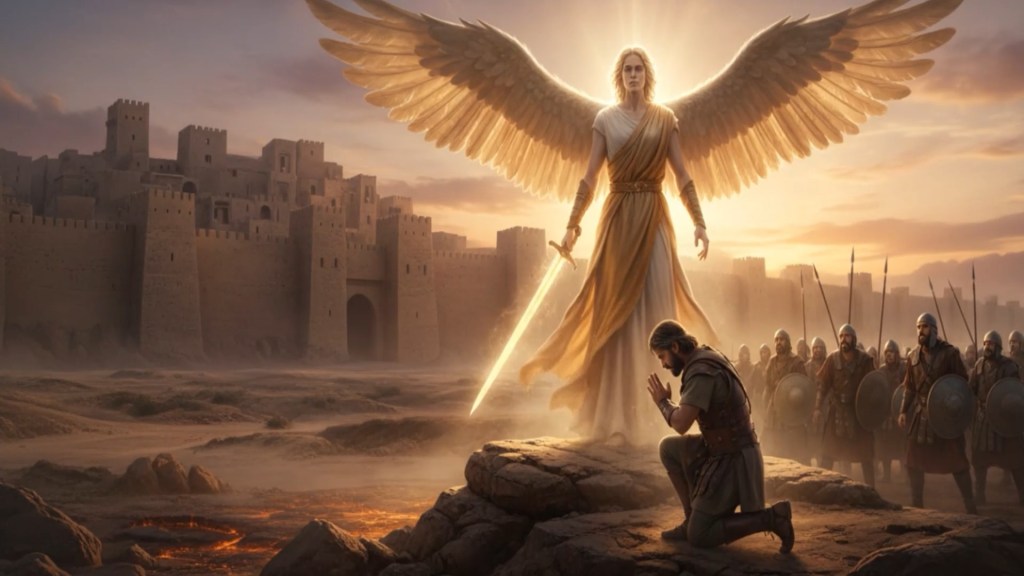
The Walls of Jericho
Joshua 5:14-15 (NIV)
7/26/26
“Are you sure this is Jesus?”
Christian Pecker
Since Grace and Christian are getting a little tired of breakfast Bible study and never want to talk about how Jesus stayed with us for forty days, way back when I was four, I decided to trick them with their own intelligence.
See, there’s a special word for when Jesus comes to visit but does not stick around. It happened all the way back, even at the start of the Bible.
The word is “theophany.”
The first part means God, and the rest means when God comes to visit in human form. When Jesus was alive in the New Testament, that was him incarnate. When he came to stay with us, that was another incarnation (even though Grace and Christian do not believe that Mr. Manning was really Jesus and say that I added a bunch to my books using my imagination). There were also times in the Old Testament when Jesus came back disguised as an angel.
Those theophanies may not have been prophecies, but they give me a chance to talk about Jesus, Mr. Manning, and a whole bunch of other neat stuff. Instead of doing beatitudes, woes, and prophecies, now we can do each theophany.
After about ten weeks of theophanies from the Old Testament, I’ll probably convince Grace and Christian that Mr. Manning really was Jesus incarnate, that Jesus is real, and was my best friend.
When we were working on the combine engine, I pretended that I couldn’t remember that one word with Christian. “When Jesus comes down to visit, what’s that called?” I asked.
“I don’t want to talk about Mr. Manning?” Christian said. “I want to get the combine up to speed.”
“Theology?” I asked.
“You cited the word more than once in your books,” Christian said. “The more accurate term might have been incarnation, but since so much of your story was imagined, Grace and I didn’t offer you any editorial suggestions there. Theophany seemed more fitting for what you often described.”
“I can’t remember it,” I said. “I’m not smart like you.”
“Why do I feel like I’m walking into a trap?”
“Grace will know,” I said. “I’ll ask her.”
“Theophany,” he said.
“I think I found a new one,” I said. “I asked ChatGPT.”
“You asked AI to find all the theophanies in the Bible, didn’t you?” Christian asked.
“Yep,” I said.
“So, you were lying?” Christian asked.
“About what?”
“Not knowing the word,” Christian said.
“I asked ChatGPT, but I forgot it again,” I said.
“What’s the theophany you’re questioning?” Christian said.
“Jesus appears to Joshua before Joshua made Jericho’s walls crumble,” I said.
“I don’t remember that taking place,” Christian said.
“Joshua 5:14-15,” I said. “It was right after God stopped the manna because the people could eat from the Canaan land.”
“Was this before or after Joshua sent spies who hooked up with Rahab in Jericho?” Christian asked.
“After,” I said.
“Is this the figure that gives Joshua the instructions to march around Jericho seven times with trumpets?” Christian asked.
“I think,” I said.
“And you say that the figure was Jesus?” Christian asked.
“I think,” I said.
“You don’t sound sure,” I said.
“Can that be the breakfast Bible study?”
Christian sighed.
Grace made breakfast.
“The figure is described as a leader of God’s army,” Christian said.
“Yep,” I said. “Jesus.”
“Are you sure it wasn’t an angel there to provide instructions?” Christian asked.
“I guess it could be,” I said. “It doesn’t say he’s Jesus, but a lot of churches teach that it is.”
“What happens next?” Christian said.
“Joshua has to take off his sandals, and Jesus tells him what to do,” I said.
“March around the city?” Christian said. “Then what?”
“They take the city when the walls crumble,” I said.
“And what happens to the people in the city?” Christian asked.
“Rahab and her family get away,” I said. “That’s the good part.”
“And everybody else?” Christian asked.
“Turned Jewish?” I asked.
“Is that what happened when cities were taken?” Christian asked.
“I guess not,” I said.
“What did happen?” Christian said.
“They killed people and took slaves,” I said.
“And Jesus facilitated that?” Christian asked. “That doesn’t sound like your Jesus.”
“They were bad people in Jericho?” I asked.
“Were they?”
“Um,” I said. “It was promised for Israel? The land, I mean.”
“According to the story, the people of Jericho were exterminated,” Christian said. “Are you sure this was Jesus giving instructions to Joshua? And if so, how do you feel about Jesus giving instructions that led to a slaughter?”
“Not good,” I said. “Oh, maybe the angel was just an angel, not Jesus.”
“I have some logic questions,” Grace said.
“Like what?” I asked.
“Joshua just walks up to a stranger and asks if he is a friend or foe?” Grace asked.
“Yep.”
“Sounds dangerous,” Grace said. “I thought angels were frightening, but maybe not this angel. Maybe this angel did look like Jesus…or was Jesus. Joshua’s army circled the city for a week, and Jericho didn’t fight back?”
“I think they probably did,” I said.
“Does the Bible say that?” Grace asked.
“No.”
“It’s sympathetic magic,” Christian said. “The number seven. The trumpets.”
“I don’t like magic,” I said.
“Is Jericho a real place?” Grace asked.
“Yep,” I said. “It’s in the Bible. I even looked it up on a map. It’s still there.”
“Tell him, Christian,” Grace said.
“Jericho is one of the oldest cities in the world,” Christian said. “It goes back long before Moses and Joshua, deep into the Stone Age. They’ve dug layers and layers. Walls did fall, but the dating is sketchy, and no evidence exists of a mass slaughter. They’re still digging and interpreting the evidence. Likely, nobody was at home during the conquest, not that the conquest ever happened as depicted in the Bible. Jericho was abandoned hundreds of years before Joshua, probably around the time of the Bronze Age collapse, and repopulated hundreds of years later. Most likely, during the time the Book of Joshua was written, people were aware of the Jericho ruins and created the story of Joshua to explain what had happened.”
“Or maybe it happened just like in the Bible?” I asked.
“If you want to believe every aspect of the story of Jericho is true, you have to accept that God facilitated the enslavement of women and children,” Christian said.
“And the slaughter of men,” Grace said.
“And livestock,” I said.
“If Jericho never fell during the time of Joshua, which is what the archaeology suggests, there was likely no need for a theophany—whether that figure was an angel, God himself, or Jesus.”
“Are you sure Joshua didn’t make it fall?” I asked.
“Look it up in archaeological journals for yourself,” Christian said. “All evidence points to those walls falling long before Joshua, during the Bronze Age collapse. Unless better evidence comes to light, I’m sticking with the current archaeology.”
In state legislatures across the country, Christian fundamentalists are passing laws meant to force the teaching of the Christian Bible in public schools. From the posting of textually inaccurate iterations of the Ten Commandments on the walls of classrooms to the incorporation of the “Trump Bible” across multiple pedagogical disciplines, these laws and mandates are sweeping the reddest parts of this nation.
The height of hypocrisy is banning books in the name of “protecting children” while mandating one particular book rife with numerous acts of sexual violence and scenes of graphic violence and genocide.
Book bans are dangerous. The Bible is worth reading and exists online and in public school libraries across the country, but proponents of mandating its formal teaching in public schools need to know what it actually says.
Some of the biblical themes in the books below might not be appropriate for children.









© Copyright UNBATED Productions 2026

