
Hezekiah was his Name-O
Isaiah 9:6
10/25/26
“Isn’t it troubling how Christian love has dovetailed so effortlessly with MAGA hate?”
Grace Pecker
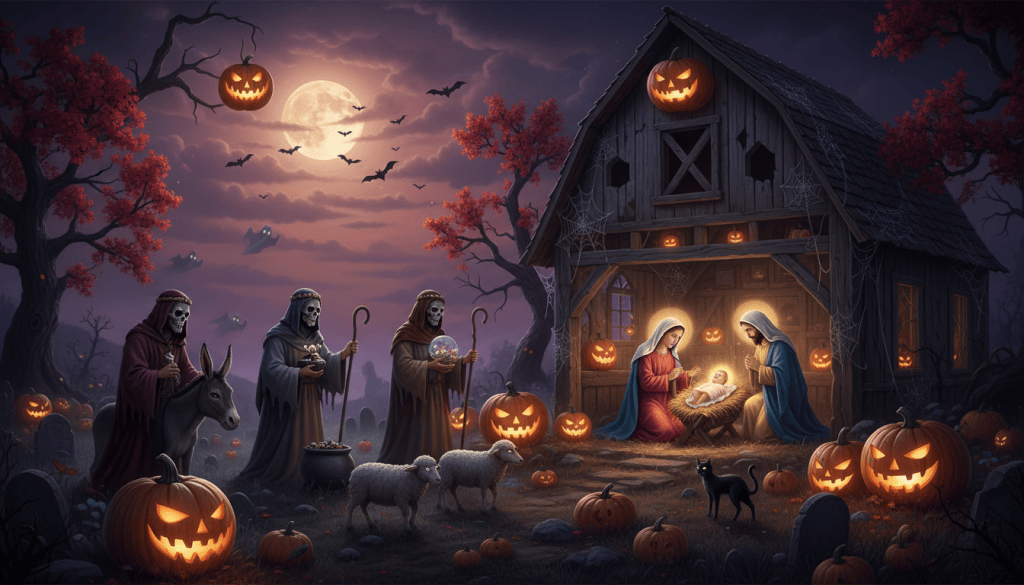
Stores put out Christmas ornaments at this time of year and take away all the Halloween junk, which is what I think Grace should do around the house, because I don’t like the scary time of year and would rather celebrate Christmas all year long. Since I lost that fight, I decided I would read a prophecy we recite in church every Christmas for this week’s breakfast Bible study:
For to us a child is born,
to us a son is given,
and the government will be on his shoulders.
And he will be called
Wonderful Counselor, Mighty God,
Everlasting Father, Prince of Peace.
“You really want Christmas to hurry up this year, huh?” Grace said.
“See, that will make next year come faster, and maybe we can make up the losses from this year, next year, because of Trump’s tariffs and wars, which made our inputs more expensive. I should have thought of this prophecy this past summer when we had more time,” I said, “but I thought it was part of a song. My question for you two is: how could Isaiah know all this stuff about Jesus if this prophecy isn’t real?”
“Are these verses describing Jesus?” Grace asked. “I don’t remember anybody calling Jesus everlasting father while he was alive. The people also never called him a mighty God, not in the Gospels.”
“They did afterward, didn’t they?” I said. “His resurrection proved it.”
“I would assume that Matthew is retconning this verse from Isaiah to fit the nativity narrative,” Christian said, “and I would argue that Matthew and later Christian translators are muddying the translation of Isaiah.”
“I knew you would say something like that,” I said.
“A Jewish friend actually explained it to me once,” Christian said. “The better translation is: ‘Wonderful counselor is my God, and everlasting father is the ruler of peace.”
“It says prince, not ruler,” I said.
“’Sar shalom’ means ruler of peace,” Christian said. “The Hebrew word for prince is ‘nasee’—not ‘sar.’”
“I don’t get it,” I said.
“The person described in Isaiah is not being called four separate things. He’s not being called wonderful counselor, mighty God, everlasting father, prince of peace,” Christian said. “He’s being called two things. He’s being called, ‘wonderful counselor is my mighty God’ and ‘everlasting father is the prince of peace.’”
“Those are statements, not titles,” I said. “‘Wonderful councilor is my God’ doesn’t sound like something you’d call someone. ‘Wonderful Councilor, Mighty God’ sounds right to me.”
“What was Jesus’ name in Hebrew?” Grace asked.
“I know that one,” I said. “Joshua.”
“Yehoshua,” Grace said. “That name means ‘God is deliverance.’”
“Yep,” I said.
“Get it?” Grace asked.
“Get what?” I asked.
“By your logic, ‘God is deliverance’ is not what you’d call somebody,” Christian said.
“Huh?”
“If ‘Wonderful counselor is my God’ doesn’t sound correct to you,” Christian said, “then ‘God is deliverance’ shouldn’t sound correct, either. Joshua means, ‘God is deliverance.’ By your logic, the name of Jesus shouldn’t sound correct, either.”
“Oh,” I said.
“Jewish names often had God in them,” Grace said. “Isra-EL. Ezekie-El. El being the name for God.”
“Even Isaiah fits the bill,” Christian said.
“Isaiah doesn’t end in El,” I said.
“Isaiah is a transliterated form of Yesha’yahu, which means ‘Yahweh is salvation.’”
“I still say it’s prophecy,” I said.
“It’s fine if you do,” Grace said, “but if you read the text in its entirety, you’ll see that Isaiah was referring to a king who lived in his own day.”
“His name was Hezekiah,” Christian said, “which translates to mighty God. During Isaiah’s lifetime, four kings ruled. Hezekiah was the last of them. Jewish scholars would tell you that Isaiah is speaking about Hezekiah, who reigned after the Assyrians were out of the picture.”
“I thought you were going to try to tell me Isaiah didn’t exist,” I said.
“He did,” Christian said, “but he probably only wrote portions that can be found in the first thirty-nine chapters of his book. After those chapters, the voice changes abruptly. The book then goes on to describe Babylonian captivity—not Assyrian rule.”
“But can’t this one passage also be about Jesus?” I asked.
“It can if you want,” Grace said, “but Christian is offering you a clearer translation and interpretation of Isaiah.”
“An interpretation that makes sense,” Christian said, “only when you realize that Isaiah is describing events that happened during his own lifetime.”
In state legislatures across the country, Christian fundamentalists are passing laws meant to force the teaching of the Christian Bible in public schools. From the posting of textually inaccurate iterations of the Ten Commandments on the walls of classrooms to the incorporation of the “Trump Bible” across multiple pedagogical disciplines, these laws and mandates are sweeping the reddest parts of this nation.
The height of hypocrisy is banning books in the name of “protecting children” while mandating one particular book rife with numerous acts of sexual violence and scenes of graphic violence and genocide.
Book bans are dangerous. The Bible is worth reading and exists online and in public school libraries across the country, but proponents of mandating its formal teaching in public schools need to know what it actually says.
Some of the biblical themes in the books below might not be appropriate for children.






© Copyright UNBATED Productions 2026

