
Paul Kicks the Goads
Acts 9
11/1/26
“Cole, you need to go vote.”
Grace Pecker
Since Halloween happened last night, Grace took down all the Halloween decorations this morning so that we could get ready for Christmas and Thanksgiving. Grace keeps talking about the election on Tuesday, but that’s not really a holiday with decorations. Nothing scary happened this Halloween, which was good, but I couldn’t find any more Christophanies in the Old Testament, meaning I would have to trick Christian and Grace.
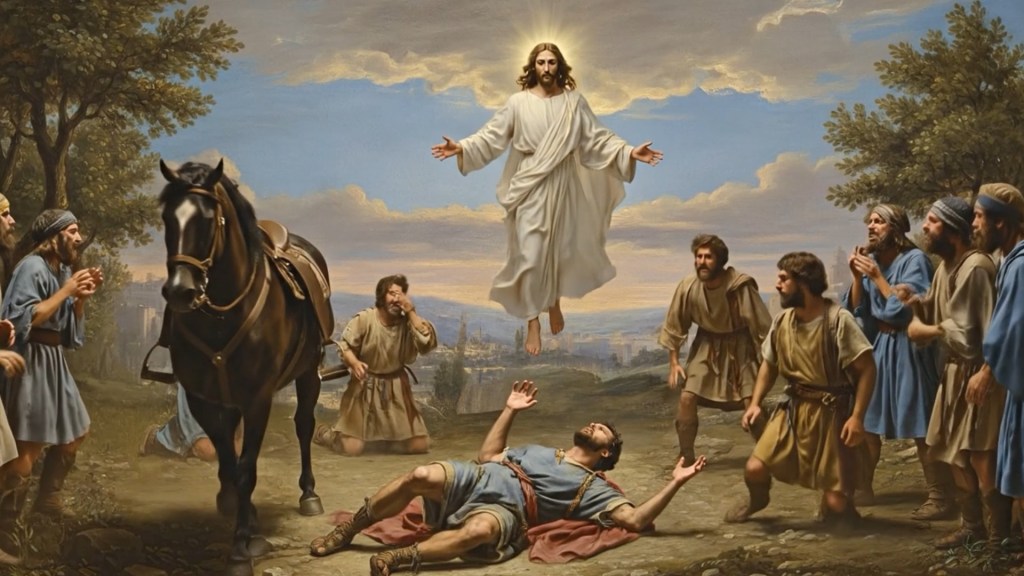
“Paul saw Jesus when he was going to Damascus,” I said.
“Paul had a vision,” Christian agreed as he poured himself coffee.
“Jesus told him not to kick the goads,” I said. “I think that means to poke people with sticks.”
“Goads were used to move livestock,” Christian said. “It’s how we get the expression about goading somebody.”
“But you said the theophanies were all Angels of the Lord and not Jesus,” I reminded them. “This one is Jesus.”
“The Book of Acts isn’t in the Old Testament,” Grace said. “At this point in the story, Jesus had lived and died, so a vision of him was possible and logical. According to Acts, Paul was persecuting early Christians, which makes the vision make even more sense.”
“But…Paul wrote all his letters before the four Gospels,” I said. “You said so yourself.”
“Sure,” Grace said, “and the author of Luke wrote Acts as a continuation of his Gospel. Paul claims he encountered Jesus in his letters, but he doesn’t go into the detail that Luke does when Luke is writing decades later. When stories get more elaborate as time passes, I have to question them.”
“But Paul did write about seeing Jesus,” I said.
“People have visions,” Christian said.
“Not of Jesus,” I said. “Having a vision of Jesus is special.”
“You had a vision of Jesus,” Christian reminded me. “It was real enough to you, but that doesn’t necessarily mean it was real to anybody else.”
“It was, too!” I said. “Paul had a real vision, too.”
“Paul attests to that in his letters, but not the details Luke adds,” Grace said. “In Galatians and 1 Corinthians, Paul describes the events but doesn’t give much detail. The Galatians and Corinthians were probably familiar with his conversion stories. His letters are reminders of his visits to them. Paul might have even told them in person that he was blinded on the road to Damascus, but he doesn’t provide those details in the letters.”
“That proves it,” I said. “Paul wrote his letters before the Gospels.”
“Speculation is not evidence, but we can agree Paul had a vision of Jesus, according to Paul and Luke,” Christian said.
“I’m right?” I asked.
“We don’t dispute that Paul had a vision of Jesus,” Grace said. “Was the vision real? Was he really blinded? He fails to mention that in the letters. Luke might have added details he heard, but that would be hearsay, unless Luke heard it from Paul himself. We just don’t know. We don’t even know if a man named Luke authored Luke and Acts. That’s speculation as well.”
“The vision certainly changed Paul,” Christian said. “Paul seemed to believe he saw Jesus. Paul profoundly influenced the early Christian church, but I am skeptical of any vision as being anything more than the product of the human mind.”
“You’re skeptical of everything,” I said.
“I find it interesting that Jesus’ disciples and Paul weren’t on the same page with each other,” I said. “The disciples were preaching what Jesus taught them. Paul developed his own theology, likely taught to him by other early Christians.”
“So?” I asked.
“That speaks to schisms in the early Church only decades after Jesus died,” Grace said.
“Who was right?”
“I think the disciples had visions, too,” Christian said, “but they were the ones who knew Jesus, while Jesus was alive. It was doubtful, however, that any of his disciples could write. Writing gave Paul an edge.”
“So, Paul was right?” I asked.
“Christianity might look different if Jesus’ disciples, the ones who knew him in the flesh, had literacy on their side,” Christian said, “but we have no early Aramaic accounts of Jesus. Aramaic was the language Jesus’ disciples knew. Paul might have known Aramaic, but from what we know, he was writing in Greek and preaching to Greco-Roman churches.”
“The other disciples couldn’t write?” I asked.
“They were peasants, fishermen,” Grace said. “Most people in that region couldn’t write.”
“Maybe the twelve disciples could,” I said. “Maybe Jesus taught them.”
“Maybe,” Grace said, “but the gospels don’t record their literacy. We do know that Paul did write or, at the least, Paul had a slave capable of writing his dictations.”
“Paul had a slave?” I asked.
“Read Philemon,” Christian said.
“Okay,” I said. “So…Paul’s vision was real, and he could write about it, so that made him win the message of Christianity?”
“Paul believed he saw Jesus,” Christian said.
“And Paul was the one whose message, for the most part, won the day,” Grace said.
In state legislatures across the country, Christian fundamentalists are passing laws meant to force the teaching of the Christian Bible in public schools. From the posting of textually inaccurate iterations of the Ten Commandments on the walls of classrooms to the incorporation of the “Trump Bible” across multiple pedagogical disciplines, these laws and mandates are sweeping the reddest parts of this nation.
The height of hypocrisy is banning books in the name of “protecting children” while mandating one particular book rife with numerous acts of sexual violence and scenes of graphic violence and genocide.
Book bans are dangerous. The Bible is worth reading and exists online and in public school libraries across the country, but proponents of mandating its formal teaching in public schools need to know what it actually says.
Some of the biblical themes in the books below might not be appropriate for children.








© Copyright UNBATED Productions 2026

